
Why Leaf Chain Is the Industry Standard for Forklift Mast Lifting
Walk into any busy distribution warehouse in Manchester, any automotive parts facility in the West Midlands, or any cold-storage operation along the Thames Gateway and you will find the same critical component quietly doing its job inside every forklift mast: a leaf chain. Sometimes called a balance chain or flat-link chain, the leaf chain is a deceptively straightforward assembly of interlocking steel plates and precision pins — yet its engineering has evolved over decades into one of the most load-reliable power transmission solutions available for vertical lifting applications.
Unlike roller chains that transmit rotational motion between sprockets, a leaf chain is designed exclusively for tension loading. It connects the forklift’s hydraulic cylinder to the carriage assembly, allowing the mast to extend smoothly while distributing the weight of the load across the full width of the chain’s interleaved plate stack. The result is a compact, high-tensile component that tolerates the millions of lift-and-lower cycles a commercial forklift accumulates across its working life.
Understanding which leaf chain specification matches your forklift model, load rating, and duty cycle is not just a matter of performance — it is a matter of workplace safety and legal compliance. In the UK, the Lifting Operations and Lifting Equipment Regulations 1998 (LOLER) mandate rigorous inspection schedules for forklift chains, making the quality and traceability of your chain supplier a direct regulatory concern.
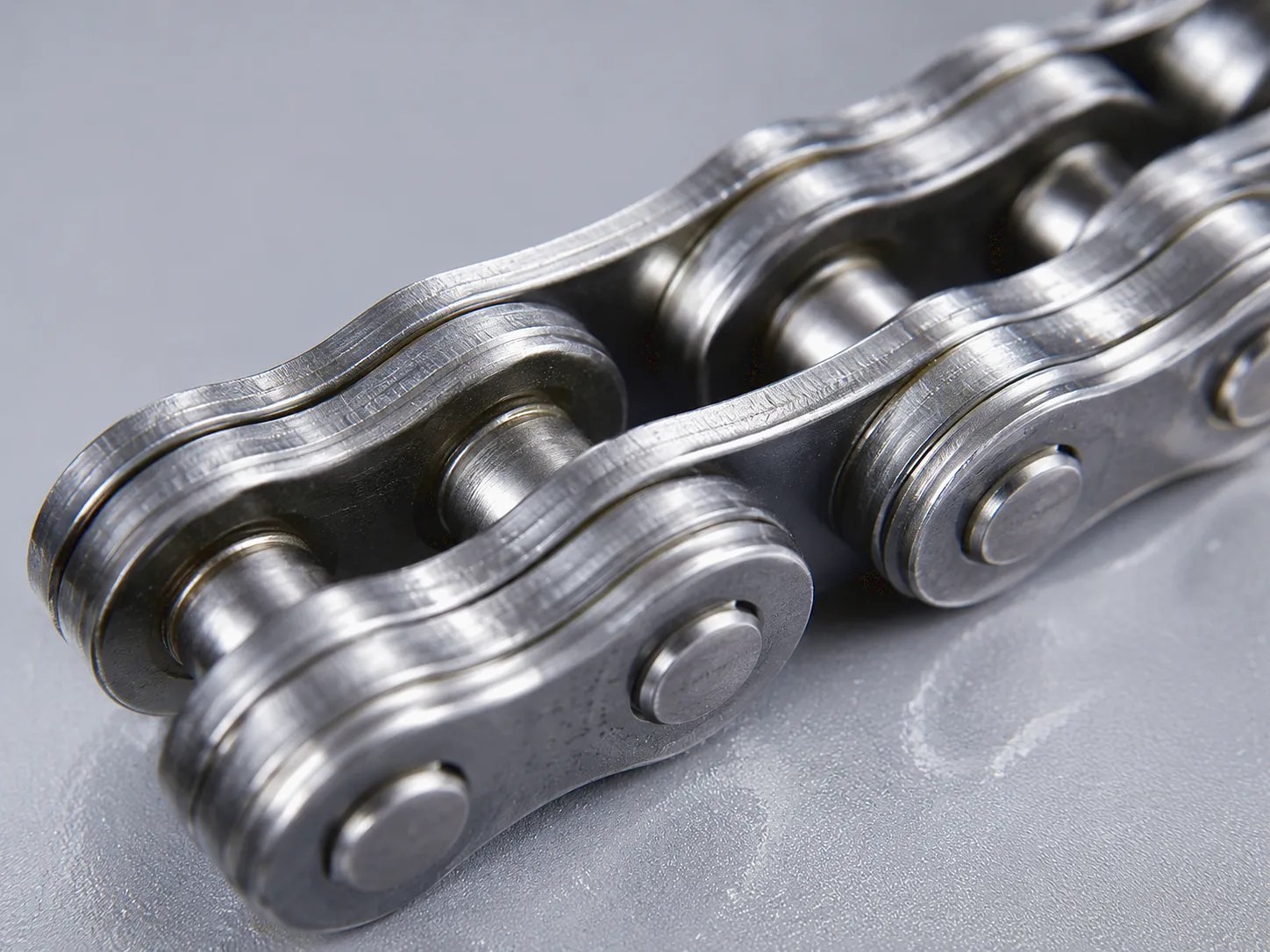
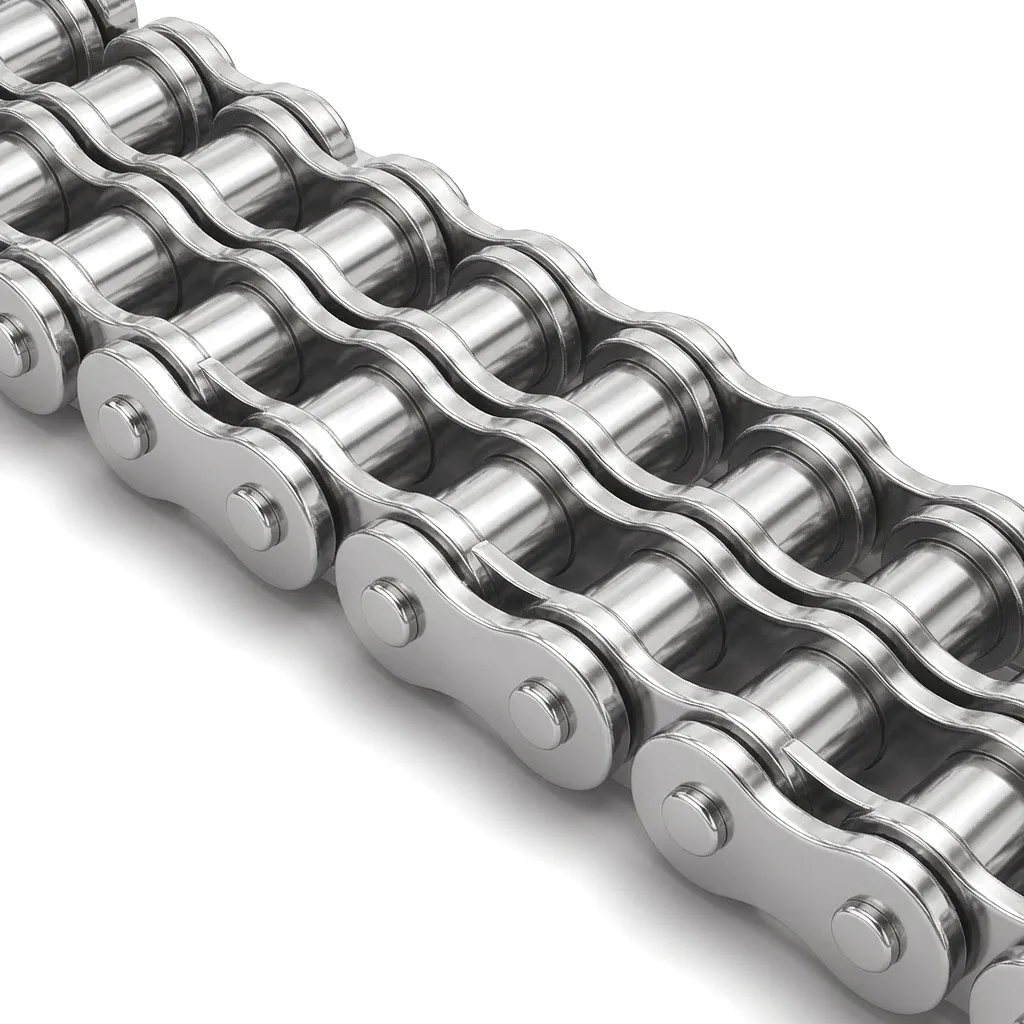
High-tensile leaf chain manufactured for forklift mast systems
Need a leaf chain for your forklift fleet? Ever Power supplies custom-cut chains to UK warehouses, ports, and logistics operators.
How a Leaf Chain Actually Works Inside a Forklift Mast
Tension-Only Loading
A leaf chain carries load exclusively in tension — it never transmits torque or wraps around a small sprocket. The hydraulic ram pushes the mast upward while the leaf chain, running over a fixed sheave, transmits that force to the carriage and forks. This pure-tensile loading regime allows designers to achieve very high breaking loads in a slender, flat chain cross-section.
Interleaved Plate Design
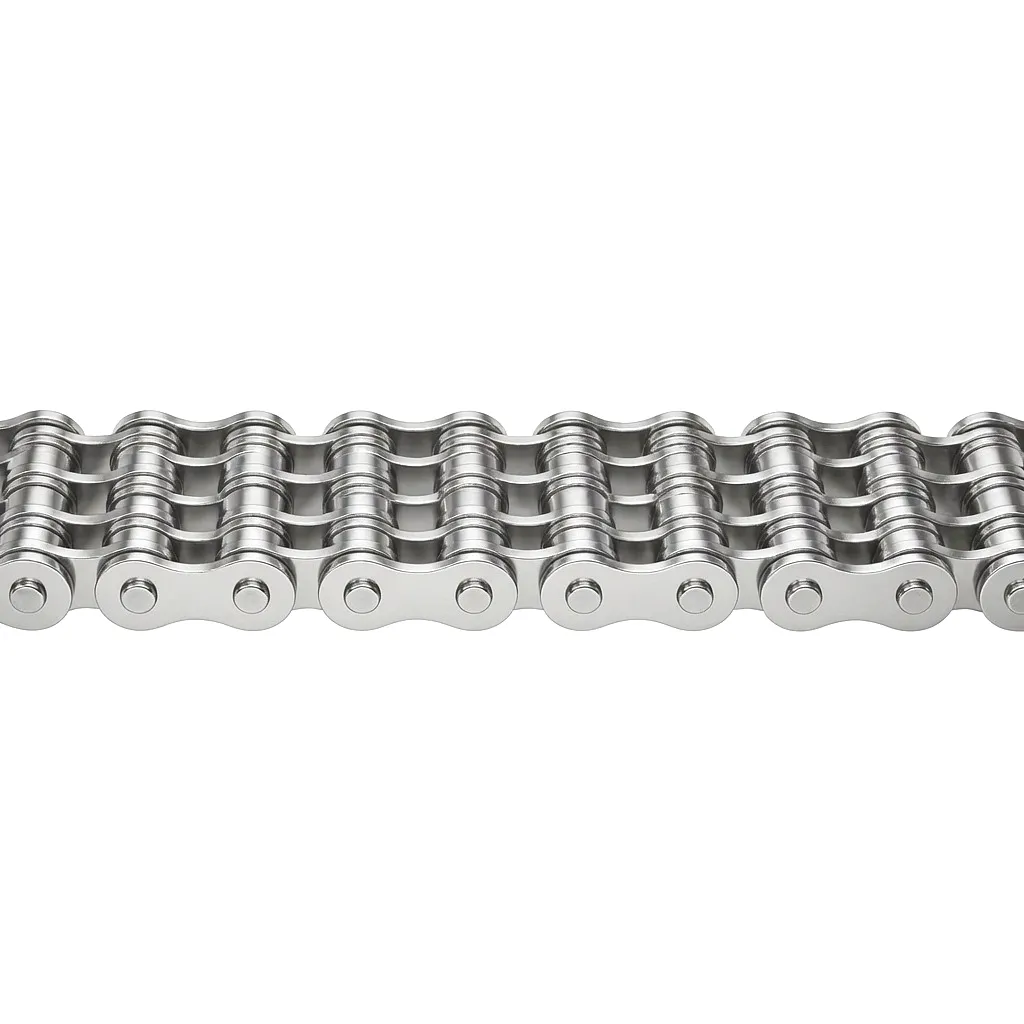
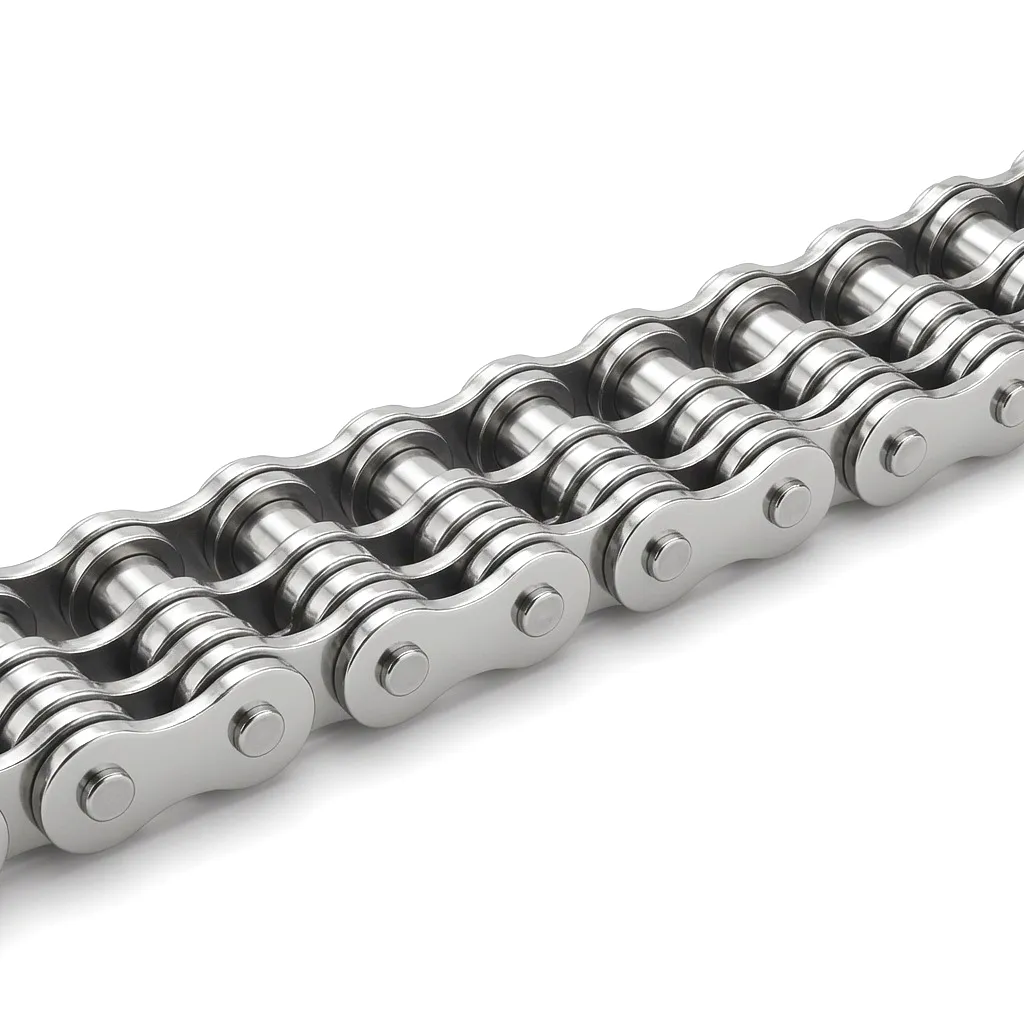
The lacing pattern — expressed as BL or AL series designations — determines how inner and outer link plates stack together. A BL823 chain, for example, features an 8-plate lacing on a 38.1 mm pitch. Thicker plate stacks increase tensile strength; tighter pitches improve flexibility around the sheave. Choosing the wrong lacing pattern for a given mast geometry can cause premature side-wear on the sheave anchor, a problem common in improperly specified aftermarket replacements.
Pin-to-Plate Contact
Wear in a leaf chain happens at the pin-to-plate bore interface. As the chain articulates over the sheave, each pin rotates fractionally inside its press-fit hole, gradually enlarging the bore. This elongates the chain’s effective pitch. Most forklift OEMs specify a maximum allowable elongation of 2–3% before mandatory replacement. Hardened pins and precisely controlled case depth in the link plates are the primary engineering levers that extend service intervals in high-cycle applications.

Close-up of precision plate lacing — the foundation of leaf chain strength
Material Composition Makes the Difference
Ever Power manufactures leaf chains from high-carbon alloy steel that undergoes a carefully controlled carburising and heat-treatment cycle. The link plates achieve a surface hardness in the range of 58–62 HRC while retaining a tough, ductile core — a combination that resists both fatigue cracking under cyclic loading and impact fracture during sudden shock events such as a dropped load or a bump over an uneven warehouse floor. Pins are ground to tight dimensional tolerances and undergo a separate surface treatment, typically phosphating followed by oil-bath impregnation, which acts as a reservoir lubricant between service intervals.
For UK customers operating in food-grade or pharmaceutical distribution environments, Ever Power also supplies leaf chains with stainless-steel link plates and non-toxic lubricants that comply with relevant hygiene standards, eliminating the risk of oil-drip contamination on product packaging.
Leaf Chain Technical Specifications for Forklift Applications
The table below covers the most commonly specified leaf chain grades for counterbalance, reach truck, and order picker forklift applications across the UK market. All tensile values represent minimum breaking load (MBL) tested in accordance with ISO 4347 and ANSI B29.8.
| Chain Series | Pitch (mm) | Lacing | MBL (kN) | Pin Dia. (mm) | Typical Forklift Capacity |
|---|---|---|---|---|---|
| BL422 | 25.4 | 4×2 | 38.5 | 7.92 | Up to 1.5 t |
| BL634 | 19.05 | 6×3 | 89.0 | 9.53 | 1.5 – 2.5 t |
| BL823 | 38.10 | 8×2 | 152.0 | 15.88 | 3 – 5 t |
| BL1046 | 38.10 | 10×4 | 285.0 | 19.05 | 5 – 10 t |
| AL1022 | 38.10 | 10×2 | 213.0 | 19.05 | 5 – 8 t, reach trucks |
* MBL values are indicative. Certified test reports are available upon request for all standard and custom orders.
What Makes Ever Power Leaf Chain Stand Apart in a Competitive UK Market
Where Forklift Leaf Chains Are Deployed Across UK Industries
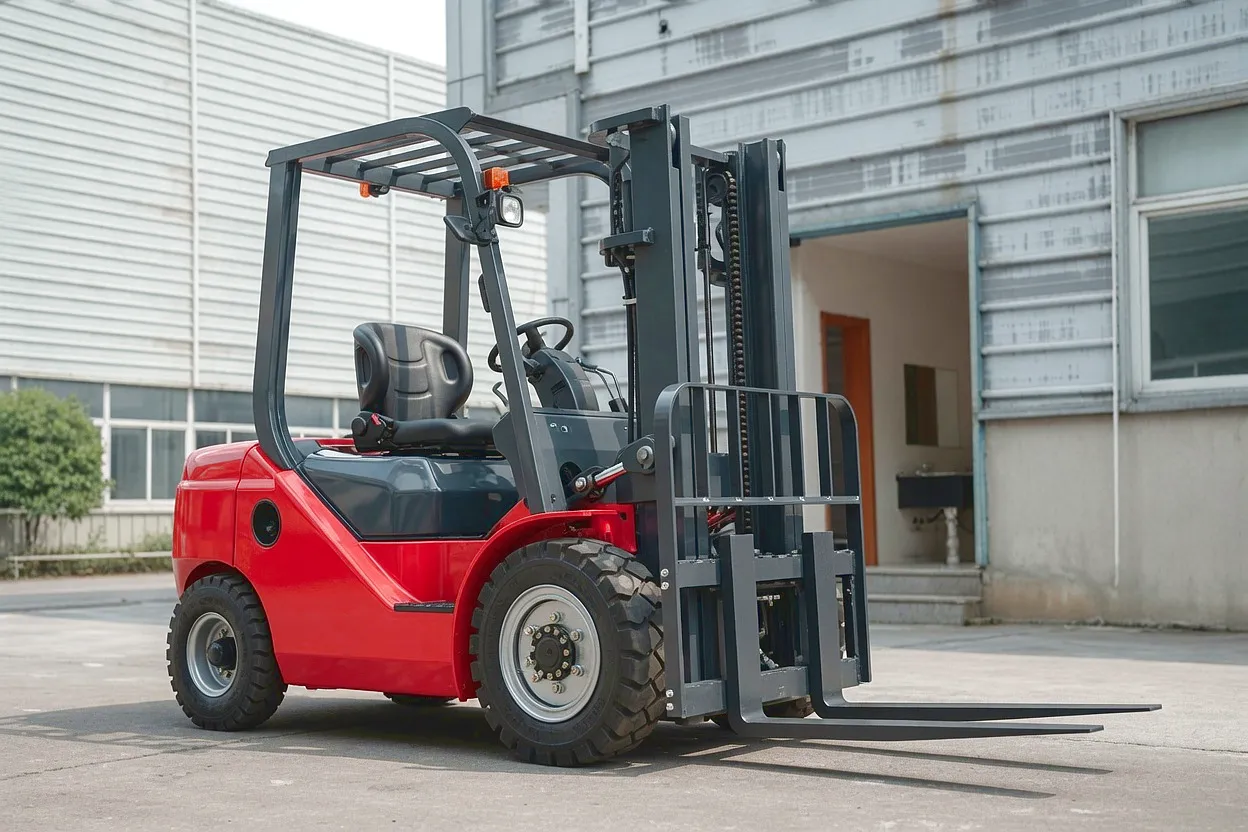


Retail Distribution Centres (East Midlands & South East)
Large retail DCs — the kind running 24/7 shifts across facilities in Corby, Daventry, and Thurrock — subject their counterbalance forklifts to some of the most punishing duty cycles imaginable. A typical electric counterbalance truck in a busy grocery DC completes 200–300 full mast extension cycles every shift. Over a 6,000-hour service life, that translates to well over one million articulation events at the leaf chain sheave. Chains specified below the minimum fatigue safety factor will show measurable elongation by year two, creating misalignment between the mast channels and the carriage roller plates — ultimately leading to jerky, uneven lifting and premature roller wear.
Specifying a properly rated leaf chain from the outset, matched to the truck’s rated capacity with the manufacturer-recommended safety factor applied, is not merely best practice — in a LOLER-audited environment it is the expected standard. Ever Power BL634 and BL823 series chains are routinely specified for 2.5 t and 3 t grocery DC trucks respectively, delivering reliable wear-rate performance across the full maintenance cycle.
Port Freight Handling (Felixstowe, Southampton & Immingham)
Reach stackers and heavy-duty counterbalance forklifts operating in UK port environments face a uniquely hostile combination of challenges: salt air corrosion, heavy shock loads from container drops, and continuous outdoor operation across all weather conditions. The leaf chain in these applications must maintain its structural integrity while resisting the electrochemical corrosion that accelerates pin-to-plate wear in saline atmospheres.
For port logistics customers, Ever Power supplies BL1046 and BL1244 series chains with nickel-plated link plates and sealed pin joints that drastically reduce moisture ingress. The sealed joint design retains an initial lubricant charge for the full service interval, eliminating the requirement for in-service chain oiling in environments where manual lubrication is impractical.
Automotive Assembly Plants (West Midlands & Sunderland)
Automotive manufacturing is one of the most demanding environments for forklift leaf chains. Assembly lines at facilities in Solihull, Coventry, and Sunderland run around the clock, with internal logistics forklifts covering enormous distances and handling everything from body panels to engine sub-assemblies. Thermal shock is a real concern — chains may move from ambient-temperature receiving docks into paint shop areas where ambient temperatures spike significantly.
Ever Power’s AL-series leaf chains, with their alternative lacing pattern designed for tighter sheave radii found in narrow-aisle reach trucks, are well-suited to automotive parts store applications where high racking density demands compact truck designs. The chains are available in pre-lubricated form with a high-viscosity chain oil that resists fling-off at elevated temperatures, maintaining the pin-to-bore lubricant film across the full operating cycle.
Cold Storage & Frozen Food Logistics
Cold store forklifts operating at temperatures between -25 °C and -30 °C place unique demands on leaf chain metallurgy. Standard chain steel becomes significantly more brittle below -20 °C, raising the risk of impact fracture during abrupt load changes or accidental collisions. Lubricants thicken dramatically at low temperatures, starving pin-to-plate contact of the fluid film needed to prevent fretting corrosion.
Ever Power’s low-temperature leaf chain grades use a modified alloy steel composition that maintains adequate ductility down to -40 °C, exceeding the operating range of most commercial cold stores. The chain is factory-lubricated with a synthetic low-temperature oil that retains a usable viscosity at -35 °C, ensuring that every articulation cycle carries a functional lubricant film even in the harshest frozen storage conditions found at facilities across Yorkshire, Lancashire, and East Anglia.
Ever Power Manufacturing & Custom Chain Engineering
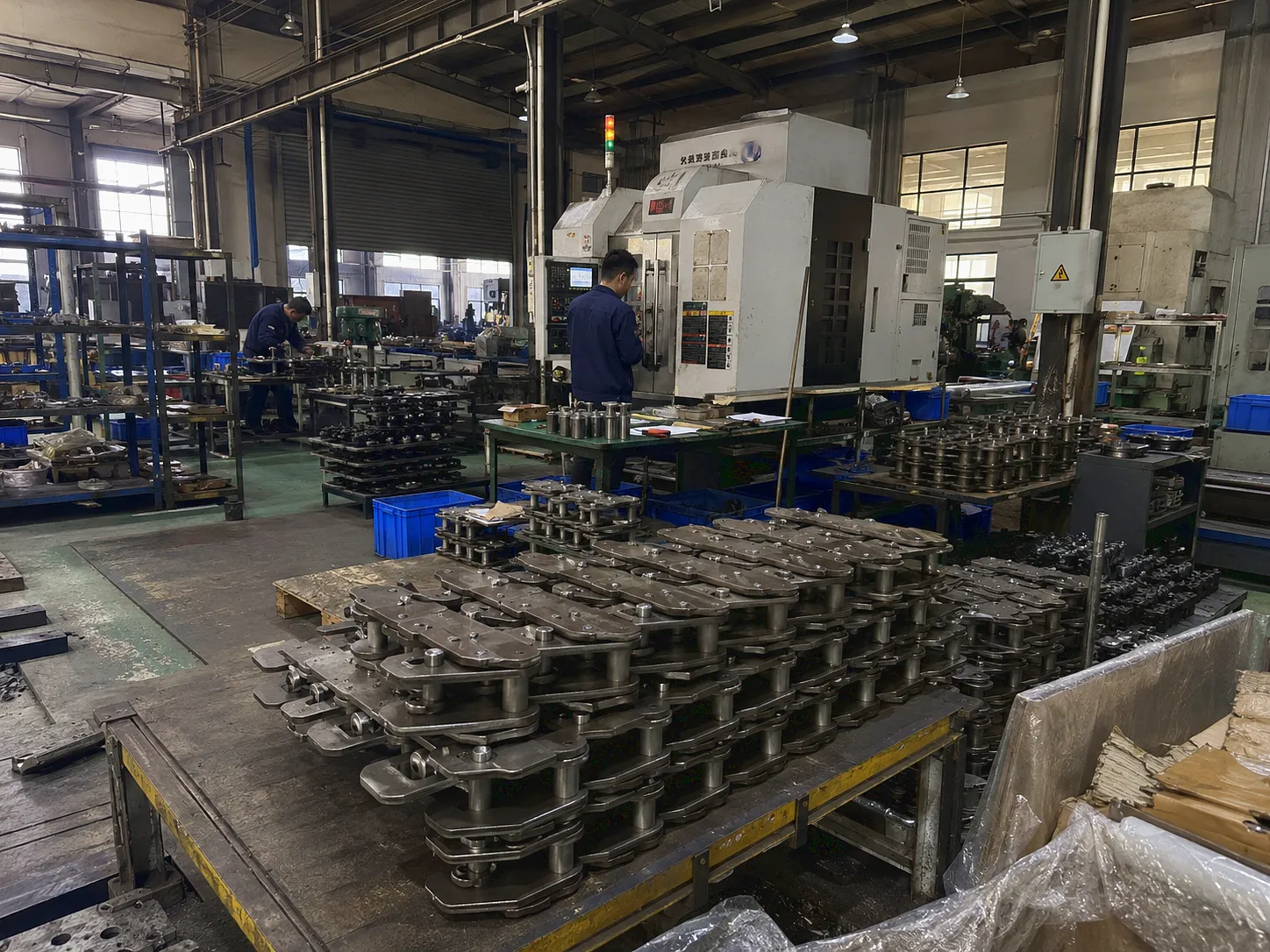
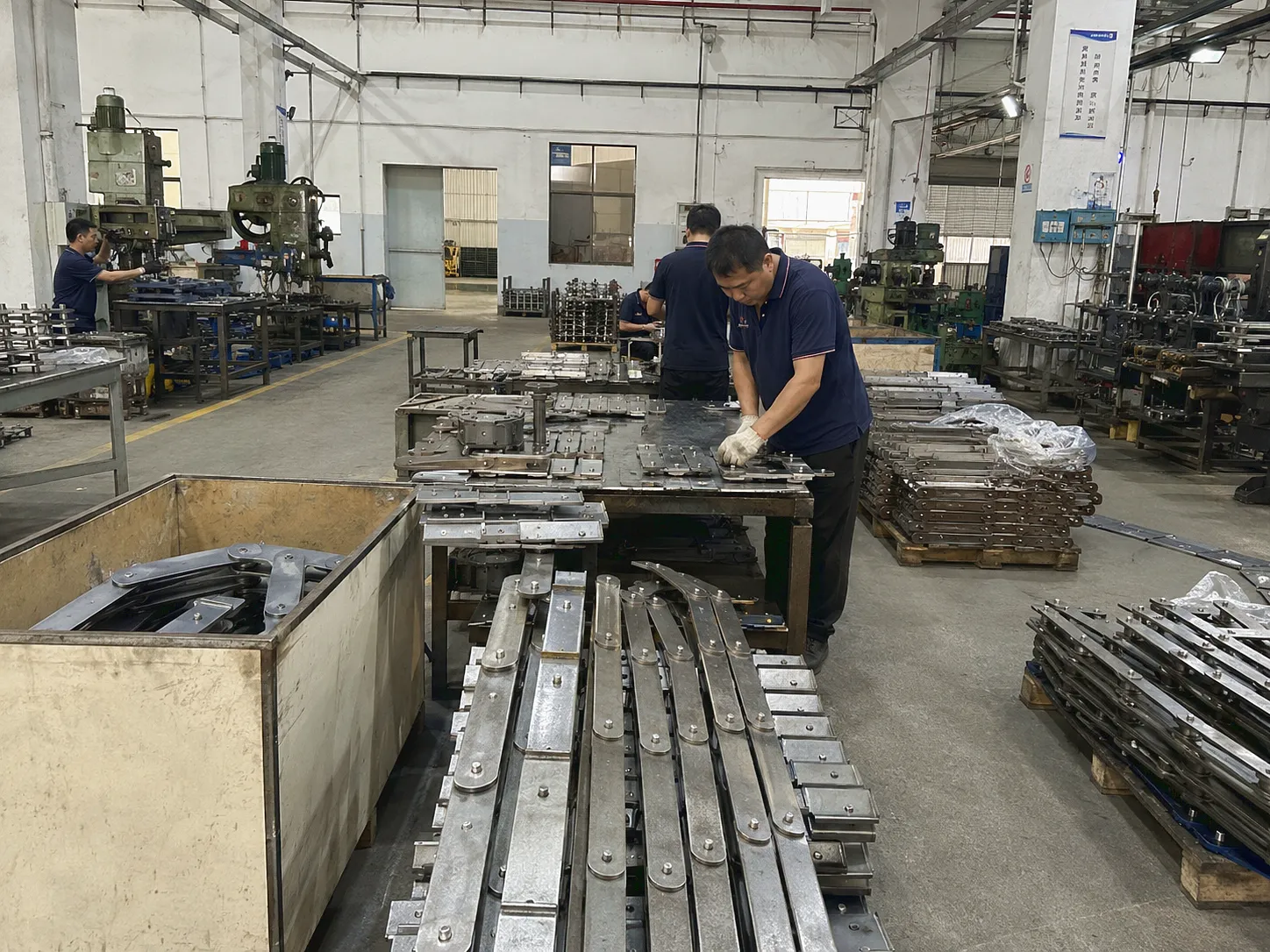
Ever Power manufacturing and quality inspection facilities
Behind every Ever Power leaf chain is a manufacturing process that combines decades of metallurgical knowledge with modern CNC machining and automated quality control. The production facility runs dedicated assembly lines for leaf chain link plate blanking, precision pin grinding, heat-treatment processing, and final assembly — each step monitored by in-process quality checks that feed real-time data into the factory’s SPC (statistical process control) system.
What genuinely sets Ever Power apart for UK B2B procurement teams is the depth of the customisation service. Standard catalogue chains cover the vast majority of forklift OEM requirements, but the engineering team regularly works with customers on bespoke configurations that no catalogue can anticipate. Recent custom projects have included extra-wide link plates for specialist crane forks, non-standard pitch chains for legacy Japanese-built reach trucks no longer in production, and chains with integrated sensor flag attachment points for automated guided vehicle (AGV) mast position feedback systems.
The customisation workflow begins with a technical consultation — usually a brief video call or email exchange — where the customer provides their mast geometry, maximum working load, duty cycle description, and any environmental constraints. Ever Power’s engineers then prepare a detailed specification drawing and quotation, typically within three working days. Prototype chains can be manufactured and shipped for fitment testing before full production commences, ensuring a perfect fit on the first service intervention.
Custom Chain Services Include:
- Cut-to-length with OEM-matched anchor fittings
- Non-standard pitch and lacing patterns
- Stainless-steel or nickel-plated plate options
- Low-temperature and high-temperature alloy variants
- Corrosion-resistant coatings for marine/port use
- Third-party certified test reports (LOLER-compatible)
- Fleet MOQ pricing for maintenance contractors
How UK Businesses Are Reducing Downtime with Ever Power Leaf Chain
Midlands Automotive Parts Distributor — Fleet of 22 Forklifts
Coventry, West Midlands · Automotive Aftermarket Distribution
 A Coventry-based automotive parts distributor operating a fleet of 22 electric counterbalance forklifts across two shifts was experiencing an unusually high rate of leaf chain replacements — averaging 4.2 chain changes per year across the fleet. Root-cause investigation revealed that the fleet manager had been sourcing unbranded replacement chains from a local hydraulics supplier, prioritising lowest unit cost over specification compliance. The chains being used had an MBL of only 89 kN on trucks rated to 3 tonnes, giving an effective safety factor of just 2.8:1 instead of the OEM-recommended 5:1 minimum.
After switching the entire fleet to Ever Power BL823 chains — correctly specified at 152 kN MBL with full OEM-equivalent anchor fittings — the annual chain replacement rate dropped to 0.7 per truck per year. Across the 22-truck fleet, this translated to a saving of 77 chain-change events annually. At an average labour and parts cost of £210 per replacement, the annual saving exceeded £16,000 — paying for the entire year’s chain supply many times over. The fleet manager also reported a meaningful reduction in LOLER inspection findings, as the correctly-specified chains showed far lower elongation rates at the 6-month inspection points.
83%
Reduction in annual chain replacements
£16k+
Annual maintenance cost saving
5:1
Safety factor achieved (OEM minimum)
“We manage a fleet of 14 reach trucks at our Northampton fulfilment centre and have been sourcing BL634 chains from Ever Power for three years. The cross-reference support saved us enormous headaches matching the right specification to three different truck brands. Delivery times have been consistent and the LOLER paperwork they provide is exactly what our compliance team needs.”
— James R., Fleet Maintenance Manager
Northamptonshire, 3PL Logistics Provider
“We operate cold-store forklifts at -22 °C and had constant issues with standard chains stiffening up after a few months. Ever Power’s low-temperature BL823 grade has been running for 18 months now without a single chain issue. The factory lubrication is holding up far better than anything we applied manually before. The price is competitive and the technical knowledge from their team is second to none.”
— Karen T., Engineering Manager
East Yorkshire, Frozen Food Distribution
“Our port operation at Immingham runs heavy-duty counterbalance trucks handling bulk steel coils up to 8 tonnes. We asked Ever Power to supply a custom BL1046 with sealed pins and nickel-plated plates for our salt-air environment. Quoted within two days, prototype delivered in a week, and the fitment was perfect first time. We have since placed a blanket order covering our full annual requirement. Highly recommended to any port operator.”
— David M., Head of Plant & Equipment
Immingham, Humberside, Port Steel Handling
Leaf Chain Compliance Under LOLER 1998 — What Every UK Fleet Operator Must Know
The Lifting Operations and Lifting Equipment Regulations 1998 apply to all forklift trucks used at work in Great Britain, and the leaf chain — as the critical tension member connecting the hydraulic system to the load-bearing carriage — is squarely within the scope of the regulations. Specifically, Regulation 9 requires that all lifting equipment, including forklift chains, be thoroughly examined at regular intervals by a competent person. For forklifts used to carry persons, this interval is every six months; for goods-only applications, at least every twelve months, though most risk assessments and manufacturer recommendations suggest a six-month schedule is prudent given the consequences of chain failure.
A thorough examination of a forklift leaf chain must include measurement of chain elongation (typically using a calibrated gauge across a defined number of chain links), visual inspection for cracking, pitting, corrosion, and plate deformation, and measurement of plate thickness to assess wear. The examination results must be recorded, and if the chain is found to have elongated beyond the manufacturer’s maximum allowable limit, it must be replaced before the forklift returns to service.
Ever Power provides full material certificates and dimensional inspection reports with every batch, giving your competent person the baseline measurements required to establish an accurate elongation trend between examination intervals. This documentation-first approach is valued by fleet operators who must demonstrate due diligence to HSE inspectors or insurance assessors following an incident.
LOLER Inspection Trigger Points for Leaf Chains
- Elongation exceeding 2% of nominal pitch length
- Individual link plates worn more than 5% in thickness
- Any visible crack in a link plate or pin
- Corrosion pitting visible on plate surfaces
- Bent or laterally distorted link plates
- Pin rotation visible from chain exterior
- Stiff joints that do not flex freely under load
- Chain stretch differential between two chains on the same mast exceeding 1.5 mm
Frequently Asked Questions about Leaf Chain for Forklift Trucks
© Ever Power Transmission · leaf-chain.com · Leaf Chain for Forklift Trucks — UK Supplier · edit by gzl