
Leaf Chain for Ring Spinning Frames: Precision-Engineered Drive Solutions for Modern Textile Mills
An in-depth engineering guide covering selection, specification, and real-world performance of leaf chain in high-speed ring spinning applications across the United Kingdom and global textile markets.
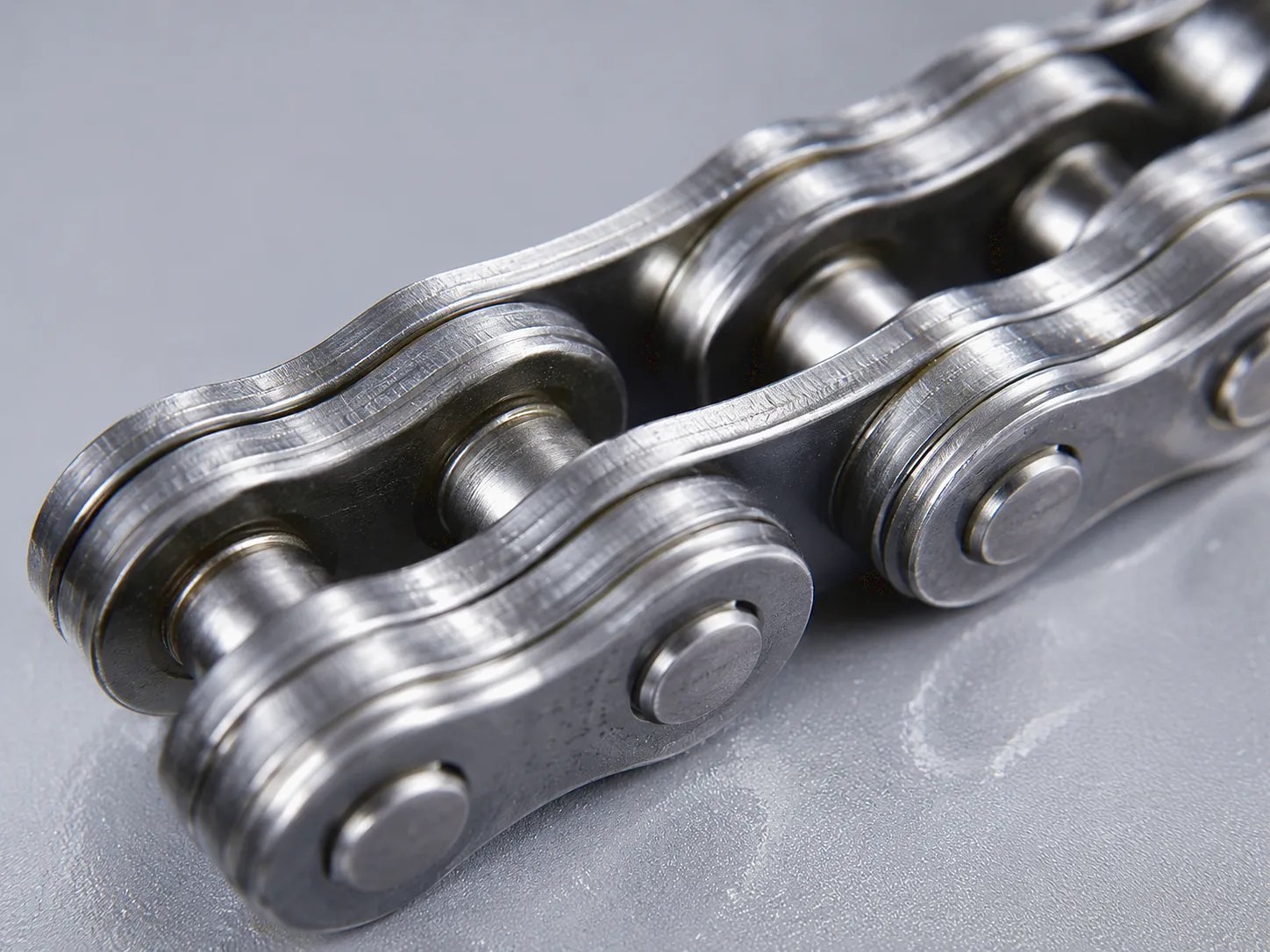 Walk through any working textile mill in Bradford, Manchester, or Leicester, and you will hear the steady hum of ring spinning frames converting roving into yarn at speeds that would have seemed impossible a generation ago. Behind that hum — hidden inside the frame’s mechanical core — sits a component that rarely gets the attention it deserves: the leaf chain. This flat, plate-link assembly is the muscle behind the precise lifting and traversing motions that determine yarn quality, bobbin build geometry, and ultimately, production throughput. When a leaf chain performs well, nobody notices it. When it stretches, binds, or fails, the consequences ripple through the entire production floor.
Ring spinning remains the dominant yarn-production method worldwide, accounting for a significant share of all spun fibre output. Every frame relies on a builder motion mechanism — driven by leaf chain — to deposit yarn evenly across the bobbin barrel. That mechanism cycles thousands of times per shift, absorbing dynamic loads, reversals, and the kind of vibrational stress that degrades lesser drive components within months. Selecting the right leaf chain for this duty is not simply a matter of matching a catalogue number; it demands an understanding of pitch, plate geometry, pin hardness, and the unique operating conditions inside a spinning mill environment where ambient humidity, fine fibre dust, and continuous vibration all conspire against mechanical longevity.
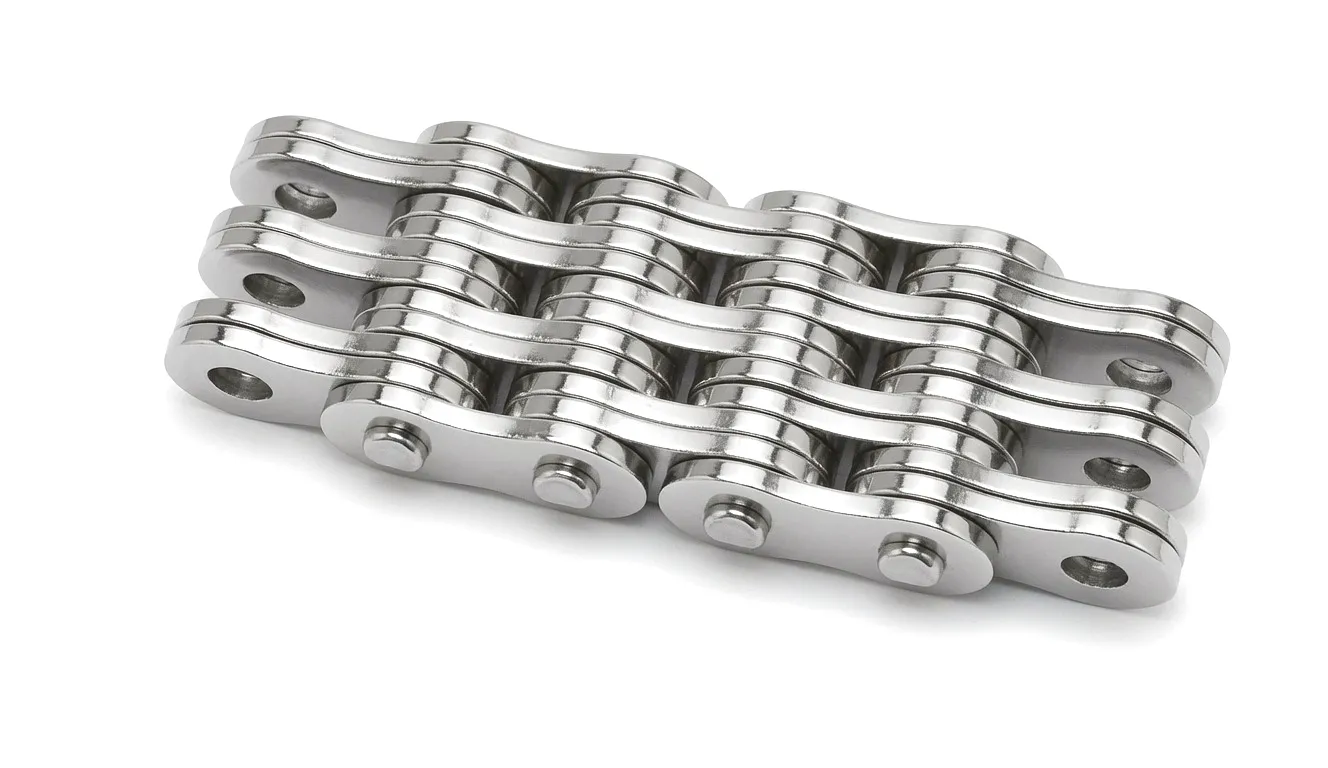
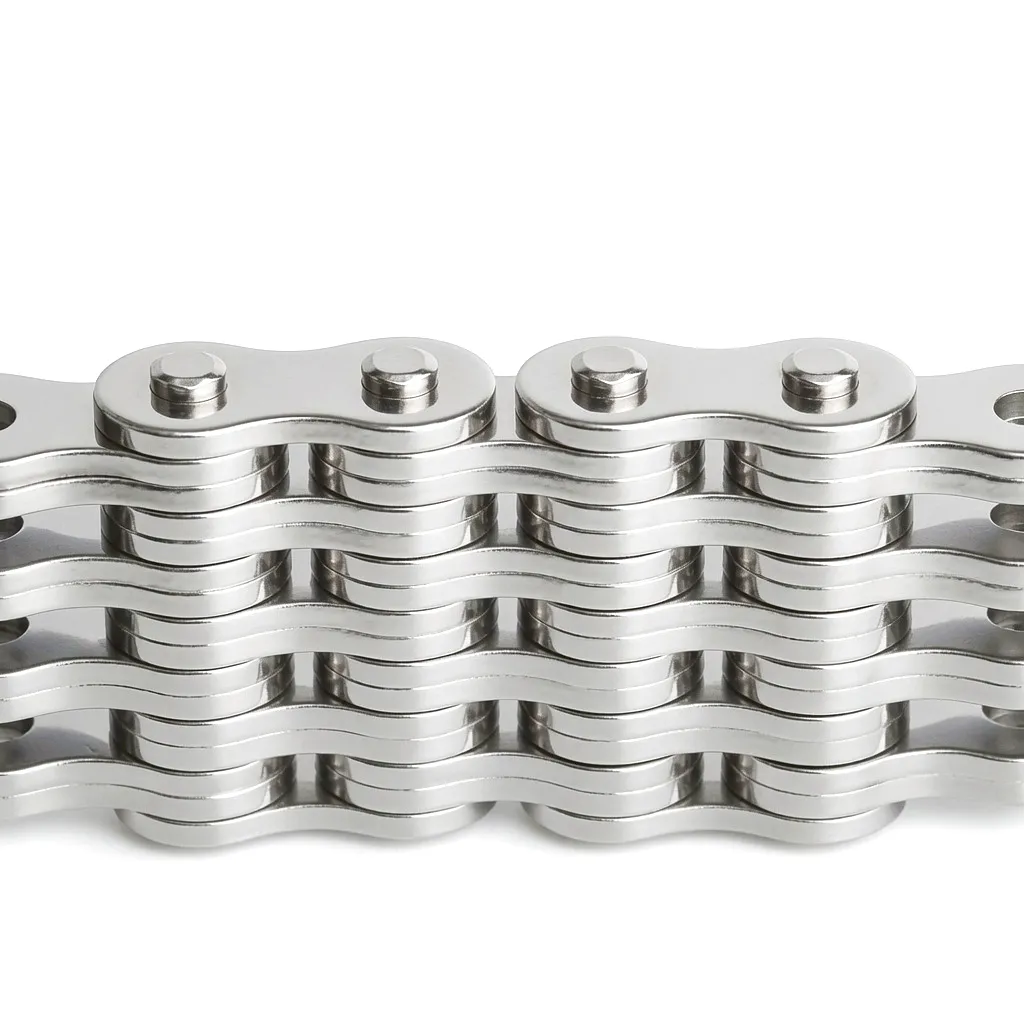
Ever Power BL-series leaf chain — engineered for the demanding duty cycles of ring spinning frame builder motions.
How Leaf Chain Drives the Heart of a Ring Spinning Frame
 A ring spinning frame transforms drafted roving into yarn by simultaneously twisting fibres and winding the finished product onto a bobbin. The winding action demands that the bobbin rail — the carriage holding every bobbin on the machine — traverse vertically in a controlled, repeating pattern. This builder motion must be precise to the sub-millimetre level. Yarn deposited unevenly across a bobbin creates hard edges, soft spots, and winding faults that show up as defects in downstream processes like weaving or knitting. The leaf chain attached to the builder motion cam translates rotary input into smooth, linear displacement of the bobbin rail, and the chain’s inherent zero-backlash behaviour keeps the motion free of jerk or hesitation at reversal points.
Most modern ring frames operate at spindle speeds between 15,000 and 25,000 RPM, generating considerable vibration that propagates through every structural member. The leaf chain must absorb these vibrational loads without developing fatigue cracks in its link plates or wearing its pins prematurely. Unlike a roller chain, which depends on rollers and bushings that can seize or gall under contamination, leaf chain relies on a simpler pin-and-plate architecture that resists particulate ingress — a vital trait in mills where microscopic fibre fragments and spinning lubricant mist form an abrasive suspension in the ambient air.
Automatic doffing further raises the stakes. When a ring spinning frame completes a bobbin, the doffing mechanism must rapidly extract full packages and replace them with empty tubes. Leaf chain drives the lifting arms and positioning cradles of many commercial doffers, executing swift acceleration-deceleration profiles that would stretch or fatigue a conventional flat belt within weeks. The chain’s positive drive ensures repeatable positioning, and its resistance to permanent elongation means the doffing cycle does not drift out of calibration between scheduled maintenance windows. For textile operators running three-shift production in facilities across Yorkshire, the Midlands, or Scotland, that kind of dependability translates directly into reduced waste and higher on-loom yarn quality.
Why Textile Engineers Specify Leaf Chain Over Alternative Drive Systems
The advantages are not theoretical — they are measurable on the production floor.

Exceptional Fatigue Resistance
Leaf chain distributes tensile forces across multiple parallel link plates, so no single plate bears the full load at any instant. In ring spinning duty — where the chain reverses direction thousands of times per shift — this load-sharing design delays crack initiation at pin-hole edges. High-carbon alloy steel plates, case-hardened to 40-45 HRC while retaining a ductile core, absorb shock loads at bobbin rail reversal points without developing the micro-cracks that propagate into catastrophic failure on inferior chains. Field data from UK textile installations shows that a properly specified leaf chain outlasts comparable roller chain by a factor of two to three in continuous ring spinning service.
Ultra-Low Elongation Under Load
Even half a millimetre of chain stretch can shift the bobbin rail’s traverse window, producing taper faults on the wound package. Leaf chain’s multi-plate construction minimises elastic and permanent elongation under working loads. Pre-loading during manufacture takes up initial pin-hole clearances, ensuring the chain arrives at the mill in a dimensionally stable state. Over a typical 18-month service interval, total elongation on a properly rated leaf chain in ring spinning duty rarely exceeds 1.2% of gauge length — well within the builder motion’s adjustment range and far below the threshold that would trigger a mid-campaign shutdown for replacement.
Compact Profile for Dense Spindle Arrangements
Ring frames squeeze hundreds of spindles into tightly packed rows. The flat, ribbon-like profile of leaf chain runs through narrow guide channels where a roller chain simply would not fit. This compactness also reduces the rotating mass of the builder motion linkage, cutting the inertia that the drive motor must overcome at each reversal. Lower inertia means less energy consumption per cycle and less heat generation in the gearing — a benefit that compounds across a full mill of spinning frames running around the clock.
Low Maintenance in Hostile Environments
Textile mills are challenging environments for any precision mechanical component. Airborne short fibres, ring traveller lubricant overspray, and humidity levels maintained for fibre processing all combine to create conditions that accelerate wear on conventional chain systems. Leaf chain’s absence of rollers and bushings eliminates the internal bearing surfaces that trap abrasive contaminants. A straightforward wipe-down and light re-lubrication during scheduled frame stoppages is typically sufficient. Many mills running Ever Power leaf chain on their ring spinning frames report maintenance time reductions of 30-45% compared to their previous roller chain installations.
Technical Specifications: Leaf Chain for Ring Spinning Duty
The table below outlines the primary specifications of Ever Power leaf chain models most commonly deployed in ring spinning frame builder motions, doffing assemblies, and creel tensioning systems. All values conform to ISO 4347 and BS/ISO testing protocols.
| Parameter | BL434 | BL446 | BL534 | BL544 |
|---|---|---|---|---|
| Tonhöjd | 12.70 mm | 12.70 mm | 15.875 mm | 15.875 mm |
| Number of Link Plates (per side) | 3 | 4 | 3 | 4 |
| Platttjocklek | 1.50 mm | 1.50 mm | 2.03 mm | 2.03 mm |
| Stiftdiameter | 3.96 mm | 3.96 mm | 5.08 mm | 5.08 mm |
| Ultimat draghållfasthet | 17.8 kN | 26.7 kN | 29.4 kN | 44.5 kN |
| Working Load (Safety Factor 5:1) | 3.56 kN | 5.34 kN | 5.88 kN | 8.90 kN |
| Chain Width (Overall) | 11.0 mm | 14.5 mm | 14.7 mm | 18.1 mm |
| Max. Elongation at Proof Load | 0.7% | 0.7% | 0.7% | 0.7% |
| Pin Hardness (Surface) | 58-62 HRC | 58-62 HRC | 58-62 HRC | 58-62 HRC |
| Recommended Application | Light-frame builder motion | Standard builder motion | Doffing mechanisms | Heavy-duty doffers / creel lift |
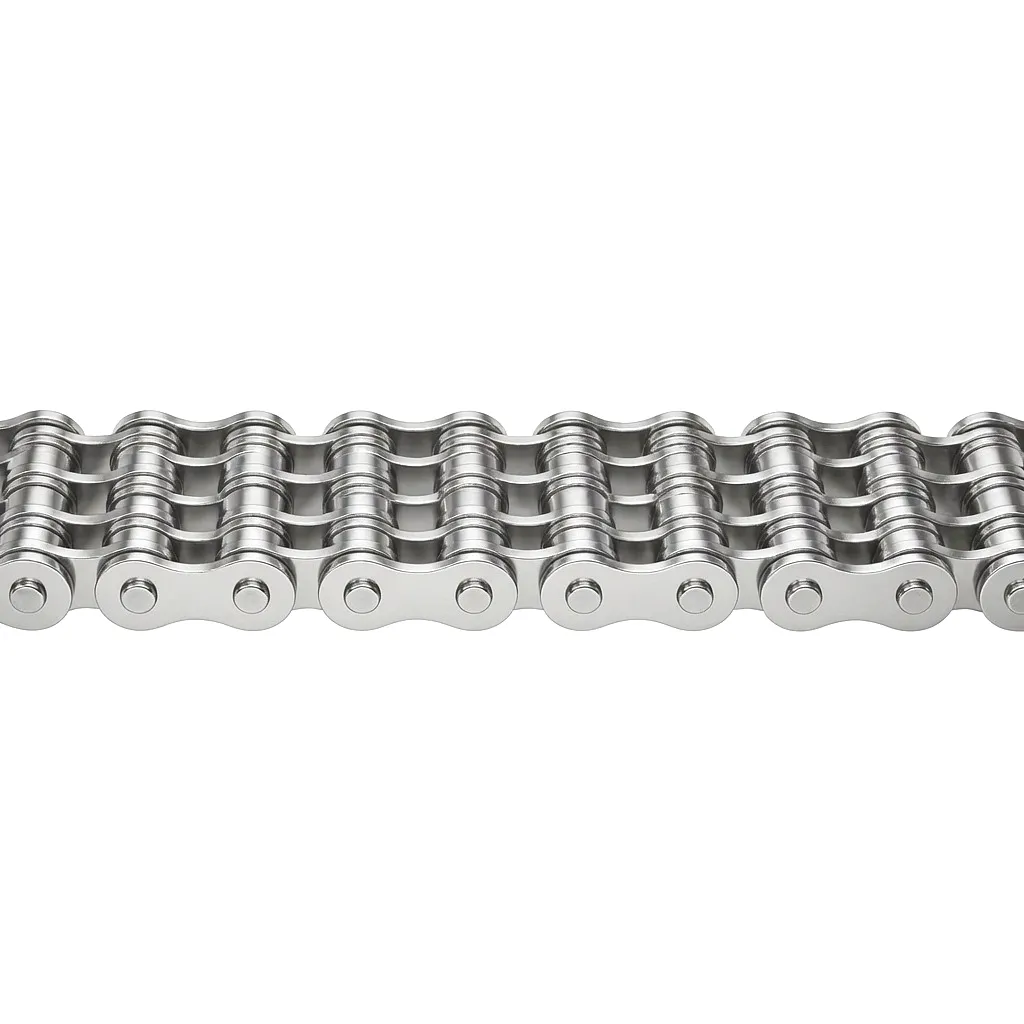
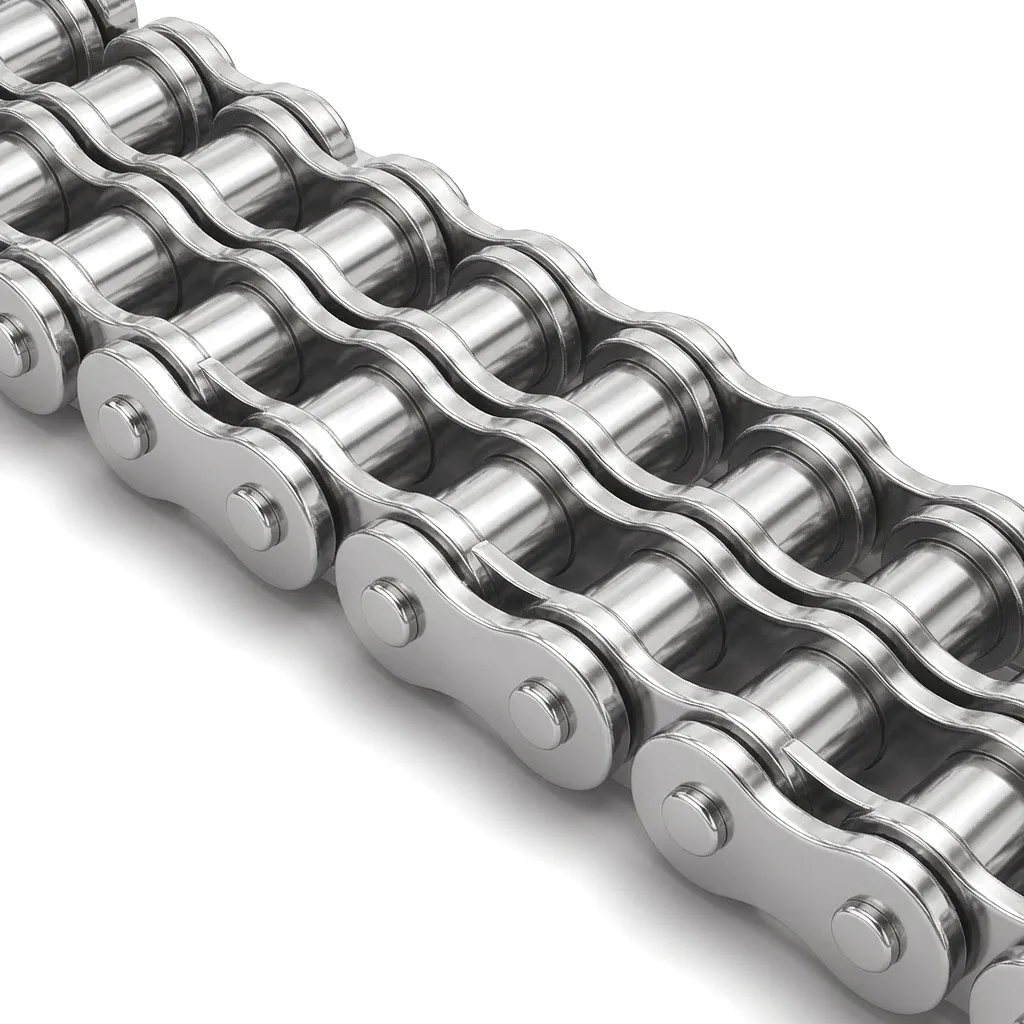
Material Science Behind High-Performance Leaf Chain
The performance ceiling of any leaf chain is set long before it reaches the mill floor — it is determined at the steel mill and during heat treatment. Ever Power manufactures leaf chain from high-carbon chromium-molybdenum alloy steel, a composition chosen for its combination of through-hardness, surface wear resistance, and core ductility. The alloy’s molybdenum content inhibits temper embrittlement, which is critical because the chain’s pins undergo induction hardening to 58-62 HRC while the pin cores must retain enough toughness to absorb impact loads without snapping.
Link plates are precision-stamped from cold-rolled steel strip using progressive dies that hold dimensional tolerances within ±0.02 mm. After stamping, every plate passes through a shot-peening station that bombards the surface with high-velocity steel media. This process introduces compressive residual stresses into the plate’s surface layer, effectively pre-loading it against the tensile stresses it will encounter in service. The result is a measurable improvement in fatigue life — independent test laboratories have documented 35-50% longer cycles to failure on shot-peened plates versus un-peened equivalents.
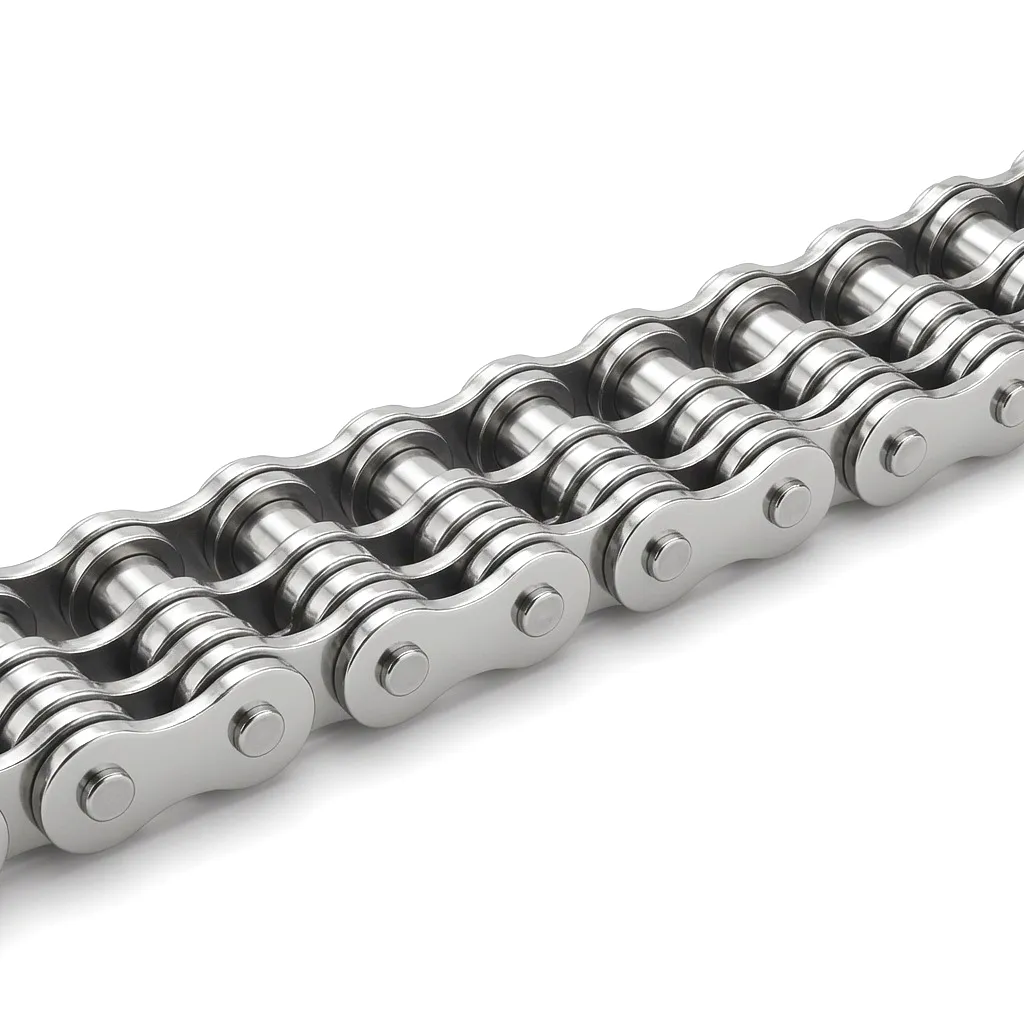
For ring spinning environments where humidity is maintained between 55-75% RH to control static and fibre behaviour, corrosion resistance matters. Ever Power offers leaf chain with zinc-nickel alloy plating or a phosphate-and-oil pre-treatment that provides a corrosion barrier without increasing plate thickness. Zinc-nickel plated leaf chain withstands over 500 hours in neutral salt spray testing (per ISO 9227), making it a reliable choice for UK textile facilities where seasonal humidity swings and unheated shed areas can accelerate ferrous corrosion.
Application Scenarios: Where Leaf Chain Works Inside a Ring Spinning Frame


Ever Power Leaf Chain Product Range

Real-World Results: Customer Case Studies
Thousands of ring spinning frames worldwide now run on Ever Power leaf chain. Three installations illustrate the kind of performance improvements that drive repeat orders.
Pennine Yarns Ltd — Bradford, West Yorkshire, UK
Worsted Ring Spinning | 48 Frames | BL446 Leaf Chain
Pennine Yarns operates 48 ring spinning frames producing fine worsted yarn for the UK suiting trade. Their original builder motion used a domestic roller chain that required lubrication every 400 operating hours and full replacement every 10-12 months due to pitch elongation. After switching to Ever Power BL446 leaf chain across all frames in early 2024, maintenance intervals extended to 2,000 hours with a simple wipe-down, and the projected replacement cycle stretched to 28-30 months. Production data showed a 2.1% reduction in yarn CV% (a key evenness metric) within the first three months, attributed to the leaf chain’s lower backlash at rail reversal. The mill’s engineering manager estimated annual savings of £18,500 in chain procurement, labour, and waste reduction across the installation.
“We trialled Ever Power leaf chain on four frames and the numbers spoke for themselves. The yarn is more even, the maintenance window is shorter, and the chain barely shows wear at twelve months. We converted the entire mill within six months.”
— James Hargreaves, Senior Engineering Manager, Pennine Yarns Ltd
Rheintal Spinnerei GmbH — Augsburg, Bavaria, Germany
Cotton/Polyester Blend Ring Spinning | 72 Frames | BL434 + BL544 Leaf Chain
Rheintal operates a large-scale blended yarn facility running ring frames at spindle speeds exceeding 20,000 RPM. Vibration-induced fatigue had been causing premature chain failure on their builder motions, with unscheduled stoppages costing the mill an estimated EUR 4,200 per incident in lost production and emergency maintenance callouts. They adopted Ever Power BL434 for the builder motion and BL544 for their automatic doffing assemblies. Over a 14-month observation window, unscheduled chain-related stoppages dropped from an average of 3.8 per month across the facility to zero. The doffing cycle accuracy improved measurably, reducing tube-placement faults by 60% and cutting the associated yarn breakage rate at restart.
“The difference in doffing reliability alone justified the switch. Our operators used to dread the vibration-fatigue failures on the old chain. Fourteen months without a single unplanned stop — that has changed how our people feel about the machines.”
— Dipl.-Ing. Markus Frey, Plant Manager, Rheintal Spinnerei GmbH
Surat Textile Industries Pvt. Ltd — Gujarat, India
Cotton Ring Spinning | 120 Frames | BL446 Leaf Chain
Operating in the humid conditions of Gujarat, Surat Textile Industries faced chronic corrosion problems on their builder motion chains, which were sourced from a regional manufacturer without protective plating. Surface rust accumulated within 8-10 weeks, increasing friction and causing the bobbin rail to stutter during traverse. Ever Power supplied zinc-nickel plated BL446 leaf chain with a corrosion-resistant finish rated for tropical humidity. After 24 months of continuous three-shift operation, a random sample chain from the installation showed no visible surface corrosion and measured elongation of just 0.8% — well within serviceable limits. The mill extended their procurement contract for an additional 200 frames scheduled for commissioning in late 2026.
“Corrosion was our biggest headache. We had tried oil baths, wax coatings, everything. The zinc-nickel plated leaf chain from Ever Power simply solved the problem. Two monsoon seasons and still no rust.”
— Rajesh Mehta, Technical Director, Surat Textile Industries Pvt. Ltd
Inside the Factory: Ever Power’s Manufacturing and Customisation Capability
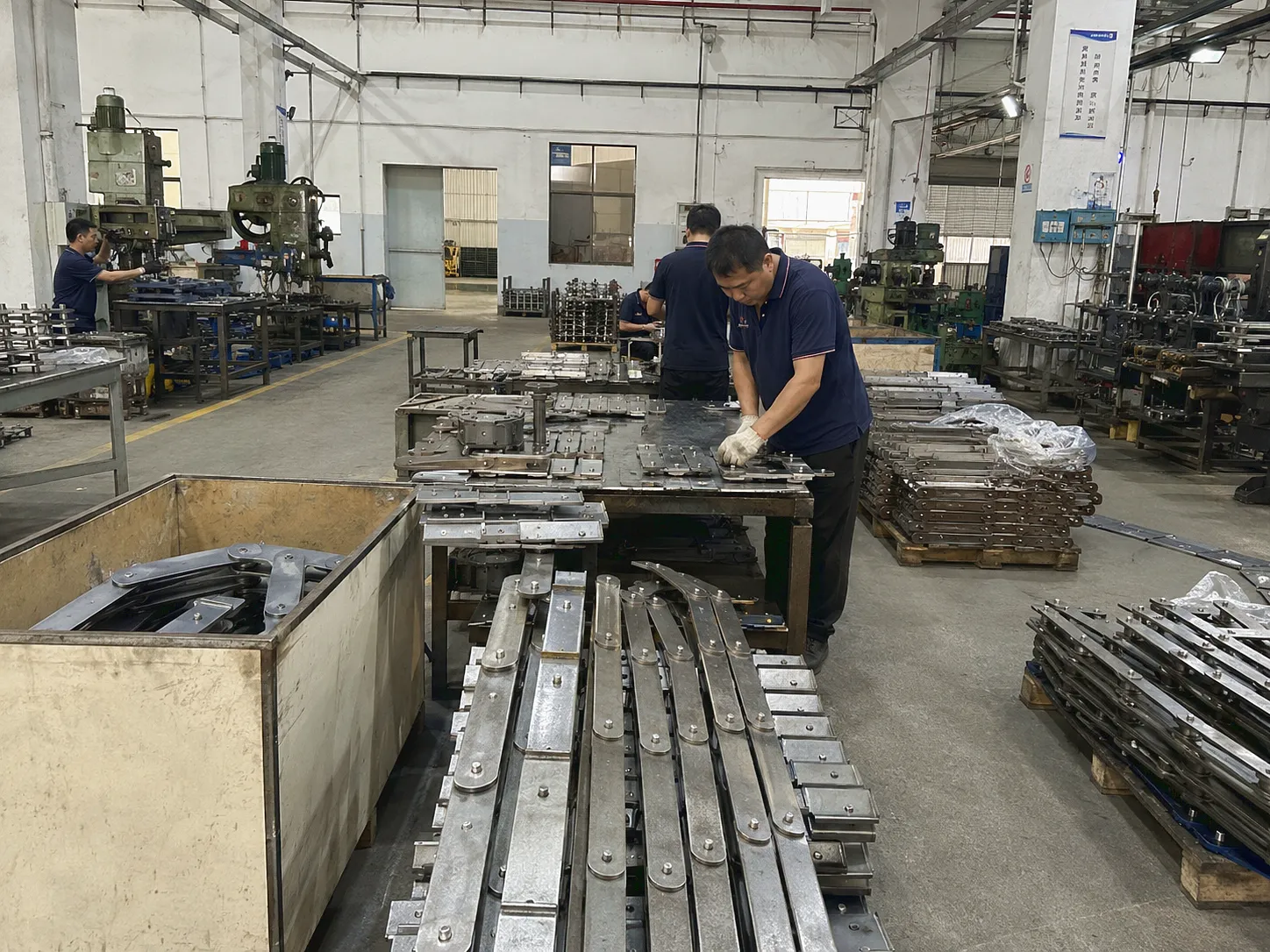
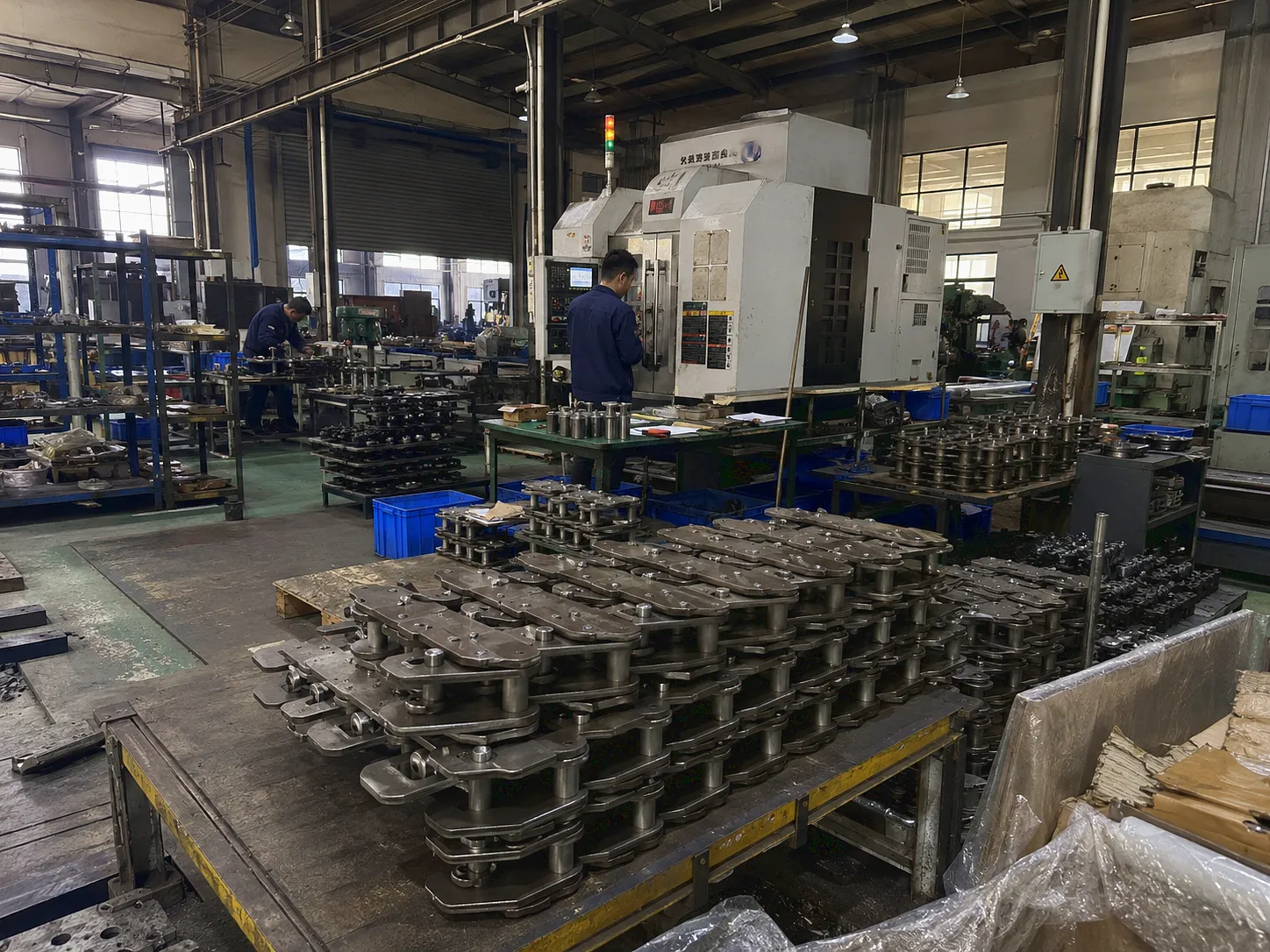
Ever Power’s leaf chain production facility covers more than 25,000 square metres, housing CNC-controlled progressive stamping lines, automated pin insertion stations, induction hardening furnaces, and shot-peening chambers. Each production batch is traceable from raw coil receipt through to final packaging. In-house metallurgical laboratories perform hardness profiling (Rockwell and Vickers), tensile testing to destruction, and dimensional verification using coordinate measuring machines (CMMs) calibrated to ISO 17025 standards.
What sets Ever Power apart from catalogue-only suppliers is the ability to customise leaf chain for specific textile machinery applications. Ring spinning frame OEMs and end-users regularly request non-standard configurations: a specific pitch with extra link plates for higher load capacity, custom pin lengths to suit a proprietary guide channel, or a unique surface treatment optimised for the ambient conditions in a particular mill. Ever Power’s engineering team works directly with clients to develop and prototype these bespoke solutions, with typical turnaround from drawing approval to first-sample delivery of 15-20 working days. Volume production follows within 6-8 weeks, depending on order size.
Bulk contract packaging, bespoke cut-lengths, and private-label branding are all available. Whether you operate a 12-frame pilot mill or a 500-frame production campus, Ever Power scales its service to match — backed by ISO 9001-certified quality management and a logistics network that reaches the UK within 10-14 days from order confirmation.
Leaf Chain Supply and Support Across the United Kingdom
🇬🇧 England
Serving textile operations in Manchester, Bradford, Huddersfield, Leeds, Leicester, and Nottingham. Standard BL-series leaf chain ships within 3-5 working days to any English address. Emergency express delivery available for breakdown situations.
🏴 Scotland
Scottish woollen and cashmere mills in Hawick, Galashiels, and the Borders region benefit from dedicated logistics routing. Technical consultations available in person or via video call for mills in the Highlands and Islands.
🏴 Wales & Northern Ireland
From the woollen mills of mid-Wales to the linen operations of Northern Ireland, Ever Power’s distribution network covers the full United Kingdom. All shipments include batch certificates, material traceability documentation, and installation guidance sheets at no extra charge.
Ever Power also maintains partnerships with UK-based industrial distributors who hold stock of the most popular BL-series bladkedja models. For mills that need same-day availability or prefer to source through a local distributor in Yorkshire, Lancashire, or the East Midlands, these partners offer off-the-shelf supply backed by Ever Power’s factory warranty and technical support. Contact our team for a list of authorised distributors in your region.
Frequently Asked Questions About Leaf Chain for Ring Spinning Frames
Where can I find a trusted leaf chain supplier for ring spinning frames in the United Kingdom?
Ever Power supplies leaf chain directly to textile mills throughout the UK, with standard delivery within 3-5 working days to England, Scotland, Wales, and Northern Ireland. The company also works through authorised distributors in major textile regions including West Yorkshire, Lancashire, and the East Midlands. Reach out via [email protected] for a quotation or to find your nearest stocking partner.
How much does a replacement leaf chain for ring spinning machinery typically cost in the UK?
Pricing depends on the chain model (BL434, BL446, BL534, etc.), total length, surface treatment, and order volume. A standard BL446 leaf chain for a typical ring spinning frame builder motion is competitively priced on a per-metre basis. Bulk contracts across multiple frames attract volume discounts. Contact Ever Power’s sales team at [email protected] with your machine model and quantity for a detailed quote — most quotations are returned within one working day.
What pitch size of leaf chain is best suited for high-speed ring spinning frames in textile mills?
For most ring spinning frame builder motions operating at spindle speeds up to 25,000 RPM, a 12.70 mm pitch (1/2 inch) leaf chain — such as the BL434 or BL446 — delivers the right balance of tensile strength, flexibility, and compact width. Frames with longer chase lengths or heavier bobbin rail assemblies may benefit from a 15.875 mm pitch (5/8 inch) chain like the BL534, which offers greater load capacity. An Ever Power application engineer can review your specific frame model and spindle speed to recommend the optimal chain specification.
How often should I replace the leaf chain on my ring spinning frame to prevent unexpected downtime?
Under normal three-shift operation with proper lubrication, Ever Power leaf chain typically delivers 24-30 months of reliable service before reaching the recommended maximum elongation of 2%. Inspecting the chain during scheduled frame stoppages — checking for pin wear, plate cracking, and gauge-length elongation — is the most dependable way to predict replacement timing. Many UK textile engineers use a simple go/no-go gauge to measure chain elongation in situ, replacing the chain proactively when elongation reaches 1.5% rather than waiting for a failure.
Which UK-based manufacturers offer bespoke leaf chain for textile spinning equipment customisation?
Ever Power is one of the few global leaf chain manufacturers offering full customisation for textile machinery, with dedicated support for UK clients. Custom options include non-standard pitch dimensions, extra link plates for increased load ratings, special surface treatments (zinc-nickel, black oxide, phosphate-and-oil), and bespoke cut-lengths packaged to your specifications. Engineering consultations, prototype development, and volume production are all handled in-house, with samples typically delivered within 15-20 working days.
What is the typical delivery lead time when ordering leaf chain for ring spinning frames from a UK supplier?
Standard BL-series leaf chain models held by Ever Power’s UK distribution partners ship within 3-5 working days to addresses across England, Scotland, Wales, and Northern Ireland. Factory-direct orders for standard models typically arrive within 10-14 days. Custom-engineered leaf chain — with special dimensions, plating, or packaging — carries a lead time of 6-8 weeks from drawing approval to delivery at your mill.
How can I get a competitive quote for bulk leaf chain orders for my spinning mill in Manchester or Yorkshire?
E-post [email protected] with your ring spinning frame make and model, the number of frames to be equipped, the current chain specification (if known), and your preferred delivery schedule. Ever Power’s UK sales team responds to quotation requests within one working day and offers volume pricing structures for multi-frame installations. Site visits for mills in the Manchester, Bradford, Leeds, and Huddersfield areas can be arranged at no cost.
What is the difference between AL-series and BL-series leaf chain for ring spinning applications?
AL-series leaf chain follows the ANSI (American) standard and uses lighter link plates, making it suitable for lower-load applications such as lightweight bobbin rail mechanisms and auxiliary drives. BL-series leaf chain conforms to the ISO/British standard and features thicker link plates with higher tensile ratings, better suited for the demanding duty cycles found in production-scale ring spinning frames. Most UK textile engineers specify BL-series for their builder motions and doffers because of the additional safety margin and longer service life it provides. Ever Power manufactures both series and can advise on the best match for your specific machine and operating conditions.
Ready to Upgrade Your Ring Spinning Frame with Precision Leaf Chain?
Talk to Ever Power’s engineering team about the right leaf chain specification for your machines — whether you run 12 frames or 500. Custom solutions, competitive pricing, and fast UK delivery are just one email away.
redigerad av gzl