
Leaf Chain for Forklift Trucks
✍️ Senior Application Engineer · 18+ Years
⏱ 14 min read
Walk into any busy warehouse — a large fulfilment centre in Birmingham, a cold-storage hub in Glasgow, a cross-dock facility outside Manchester — and you will find forklift trucks operating at the heart of the materials-handling operation. These machines work punishing cycles: raising, lowering, travelling, tilting, hour after hour. Every time the mast extends, the leaf chain carries the load. Every time a driver drops a pallet at height, the leaf chain absorbs the shock. And yet, for all the engineering thought that goes into mast geometry, hydraulic circuits, and counterweight design, the chain itself is routinely under-specified or replaced on price rather than performance.
Having spent more than eighteen years working directly with forklift manufacturers, fleet operators, and maintenance engineers, I have seen the consequences of that under-specification play out repeatedly — and they range from premature wear and unplanned downtime to, in the worst cases, catastrophic mast failure. The purpose of this article is to put that right: to explain exactly what leaf chain for forklift trucks is, how it works, what the materials and engineering parameters actually mean, and how procurement and engineering teams in the UK can make better decisions.
What Exactly Is Leaf Chain — And Why Does It Dominate Forklift Design?
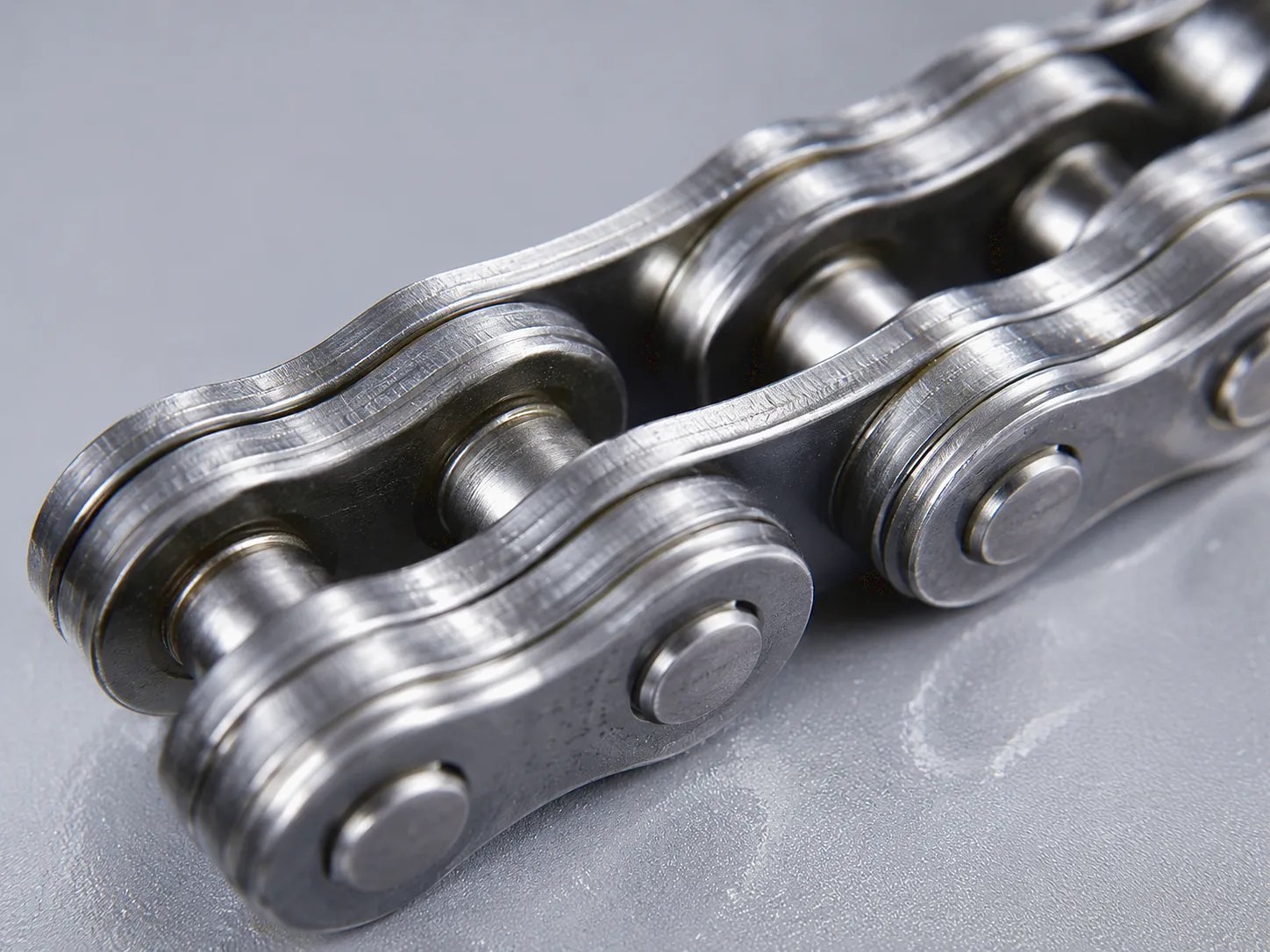
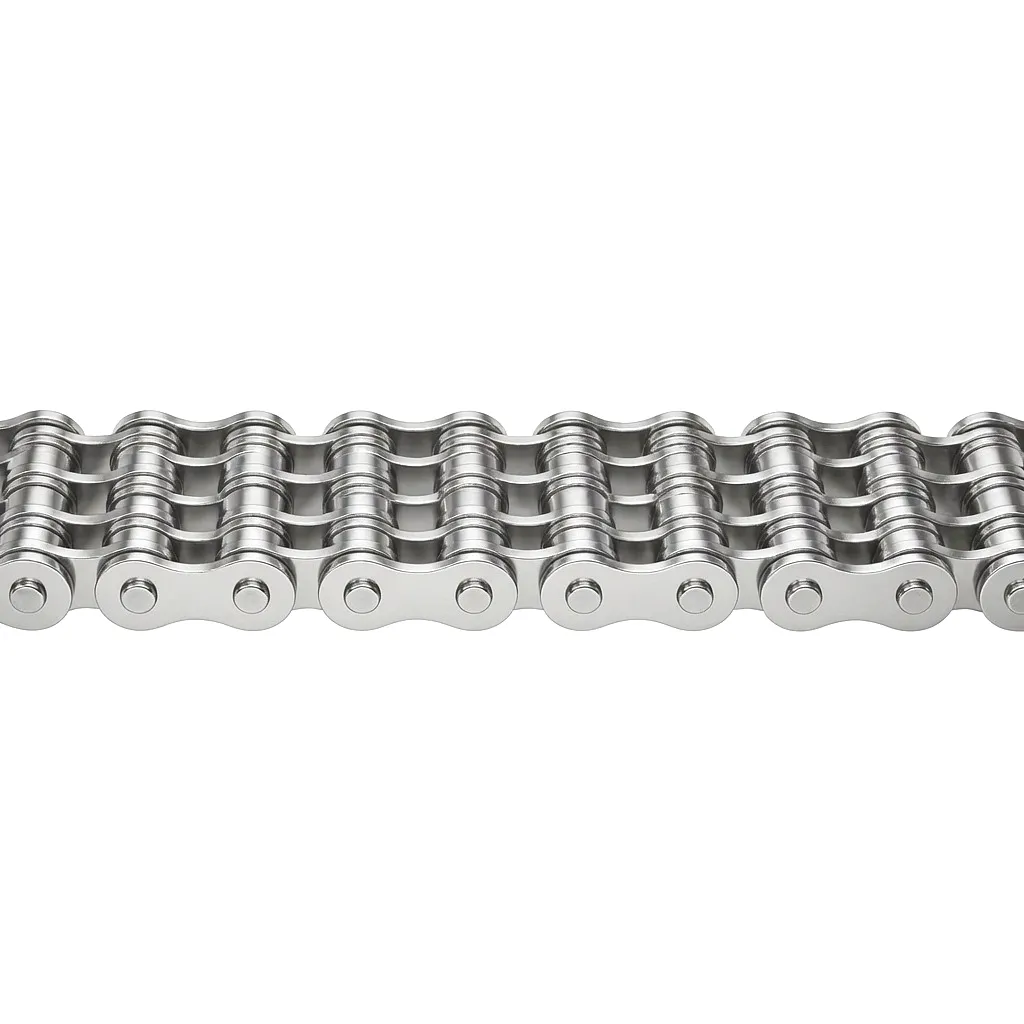
Leaf chain — sometimes written as leafchain or referred to by the ISO designation FL (for “flat link”) — is a type of transmission chain built from interlocking metal plates (leaves) connected by pins and cotters. Unlike roller chain, which is designed for sprocket-driven power transmission, leaf chain is a tension component: its sole purpose is to carry a load in a straight line. In a forklift mast, two or more leaf chains run over fixed sheaves (pulleys) and connect the carriage to the hydraulic ram, translating the cylinder’s push into vertical carriage movement. The design is elegantly simple, but the loads involved are anything but.
The fundamental advantage of leaf chain over wire rope — the alternative used in some older designs — is its defined elongation behaviour. Under load, leaf chain stretches in a predictable, measurable way. When elongation reaches a specific percentage (typically 2–3% over a standardised test length), this is a well-established signal that the chain has reached the end of its service life. This predictability is central to planned maintenance programmes and statutory lift truck inspection regimes, including those required under LOLER (Lifting Operations and Lifting Equipment Regulations 1998) in the United Kingdom.
From a materials perspective, forklift leaf chain is manufactured almost exclusively from high-carbon or medium-carbon alloy steels, with link plates typically heat-treated to achieve hardness values in the range of 40–50 HRC. The pins, which carry the bearing loads between plates, are ground to tight tolerances and may be induction-hardened on the surface to resist wear while retaining a tough core. Every millimetre of tolerance, every heat treatment cycle, and every surface finish specification feeds directly into the service life you will actually achieve in the field.
Inside the Forklift Mast: How Leaf Chain Actually Works Under Load
 Understanding the mechanics inside a forklift mast makes it much easier to appreciate why chain selection matters so much. A counterbalance forklift typically uses a duplex (two-stand) or triplex mast arrangement. In a simplex mast, a single-acting hydraulic cylinder raises the carriage directly. In a duplex or triplex mast, the free-lift cylinder first raises the inner mast section relative to the outer, before a separate full-lift cylinder elevates the carriage to full height. Leaf chains are used at multiple points in this kinematic chain, and the loads they see are not simply the rated capacity of the truck.
Dynamic loading is the reality of forklift operation that static calculations often miss. When a heavily-laden fork reaches the top of its travel and the hydraulic system holds position, the load appears static. But when the truck accelerates, brakes, or turns — especially with a raised load — the effective load on the chain increases dramatically. Industry practice requires leaf chains to be rated with a minimum safety factor of 5:1 over working load limit under static conditions, but the actual dynamic multipliers experienced in fast-paced warehouse environments can push instantaneous chain tensions significantly higher. This is why the published breaking load of a leaf chain is not a theoretical maximum — it is the engineering floor from which safety factors are calculated.
Material Grades, Construction Types & Key Technical Parameters
The material specification of a leaf chain is the single most important variable governing its service life. At EP, our forklift leaf chains use medium-carbon chromium-molybdenum alloy steel for link plates — a grade that delivers an exceptional combination of tensile strength, toughness, and resistance to fatigue crack propagation. Where stainless steel variants are required for food processing applications or pharmaceutical cold stores in the UK, we manufacture to Grade 316L, accepting the modest strength reduction in exchange for corrosion immunity.
Pin materials follow the same philosophy: carbon-chrome steel, case-hardened to 58–62 HRC on the surface to resist the abrasive wear that occurs at the pin-plate interface under oscillating load. The difference between a ground pin and a rough-turned pin is not cosmetic — under the microscope, surface finish directly determines the thickness of the lubricant film that can be sustained, and a thin or absent lubricant film is the primary mechanism for accelerated chain wear in the field.
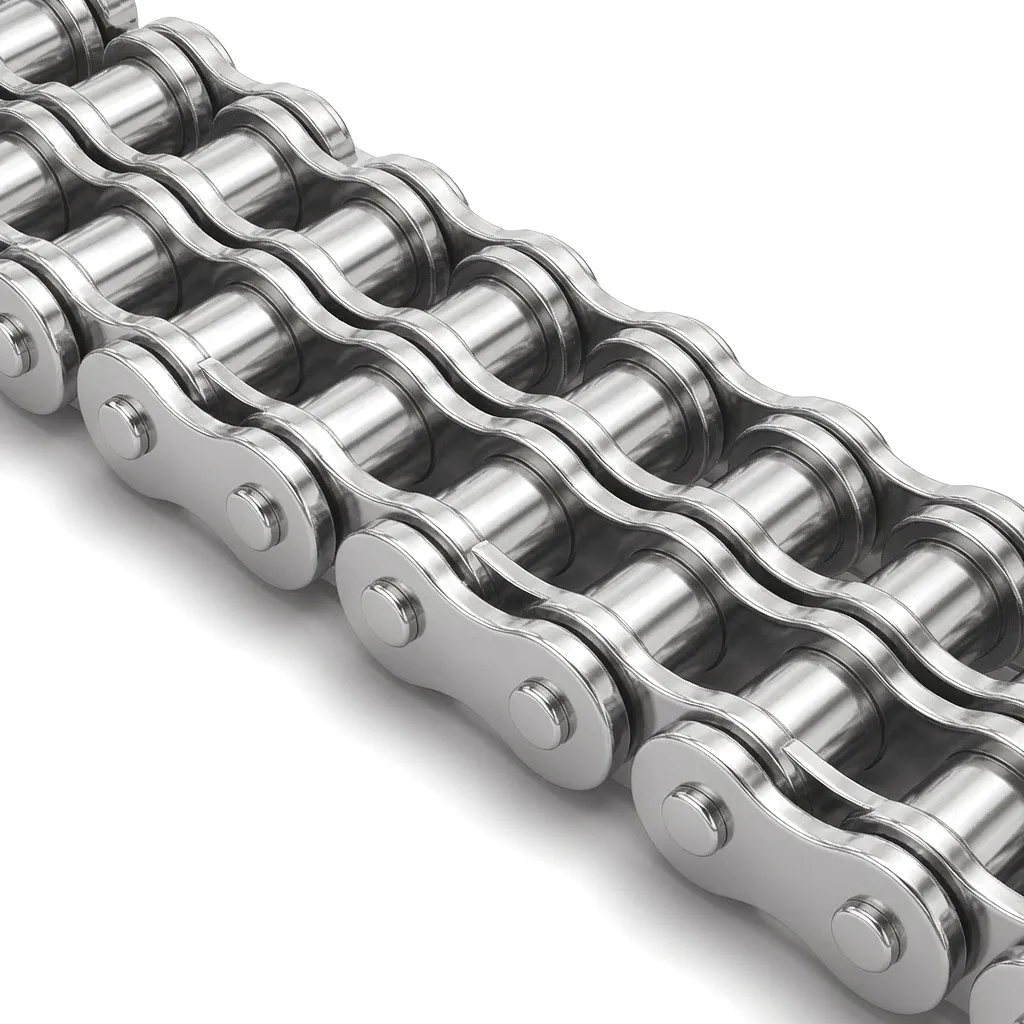
| Chain Series | Pitch (mm) | Lacing Config | Min. Breaking Load (kN) | Typical Forklift Application | Material Standard |
|---|---|---|---|---|---|
| BL 422 | 12.70 | 2 × 2 | 38 | 1.0–1.5 t counterbalance | ISO 4347 / DIN 8152 |
| BL 522 | 15.875 | 2 × 2 | 56 | 1.5–2.5 t counterbalance | ISO 4347 / DIN 8152 |
| BL 634 | 19.05 | 3 × 4 | 148 | 3.5–5.0 t reach/counterbalance | ISO 4347 / DIN 8152 |
| BL 844 | 25.40 | 4 × 4 | 280 | 5.0–10.0 t heavy counterbalance | ISO 4347 / DIN 8152 |
| BLL 1044 | 31.75 | 4 × 4 (extended pin) | 420 | 10.0–16.0 t heavy lift truck | ISO 4347 / DIN 8152 |
Where Leaf Chain Performs: Forklift Application Scenarios Across UK Industries
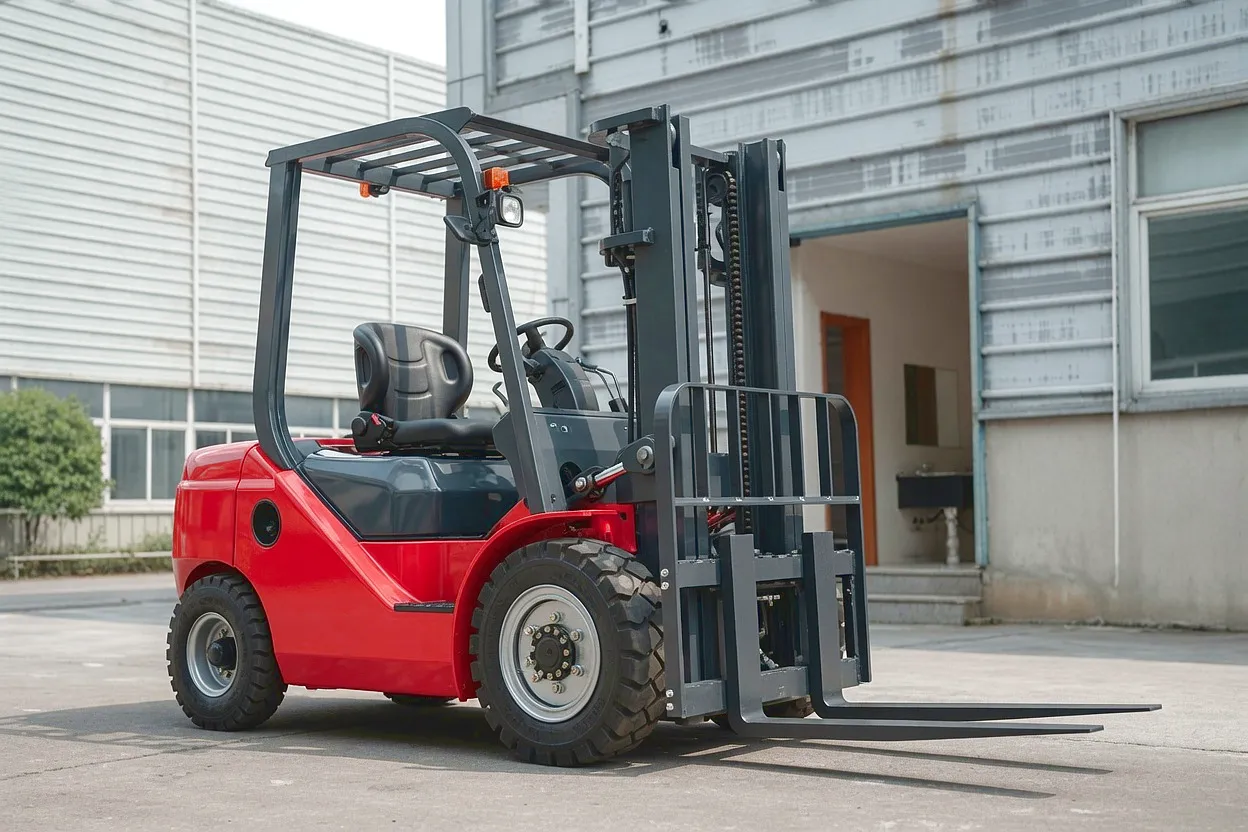
The phrase “forklift truck” covers an enormous range of equipment types and operating environments. A reach truck working in a narrow-aisle racking system in a Midlands third-party logistics (3PL) warehouse faces very different demands on its leaf chain compared to a rough-terrain forklift shifting steel coils at a port in Teesside, or a pallet truck manoeuvring in a chilled distribution centre in Yorkshire. Recognising these distinctions is how experienced procurement engineers and fleet managers get consistently longer service life from their chains.


Why EP Leaf Chain Outperforms in Forklift Service Life
Choosing leaf chain is not purely a specification exercise — it is a decision about total cost of ownership, safety compliance risk, and operational continuity. After years of working with UK forklift fleet managers, these are the performance advantages that matter most in practice.
Ground to Ra ≤0.4 µm surface finish. Sustains a full lubricant film under oscillating load, extending pin-plate bearing life by 40–60% versus rough-turned alternatives in equivalent duty tests.
In-house continuous furnace heat treatment with atmosphere control. Every batch tested for hardness and microstructure conformance before dispatch. Eliminates the brittle intergranular structures that cause sudden fatigue fracture.
Full dimensional and mechanical conformance with ISO 4347 and DIN 8152. Supports LOLER documentation, equipment CE marking, and third-party inspection reports — essential for UK fleet operators managing compliance obligations.
BLL extended-pin configurations, custom anchor end fittings, clevis connectors, and specialised carriage attachments produced to customer drawings. No MOQ on custom work for established account holders.
Standard grade: -20°C to +120°C. Stainless grade: -40°C to +300°C. High-temperature versions for steel and foundry fork operations at +200°C ambient. Verified in climate-chamber test programmes, not just theoretical calculation.
Standard BL/BLL series held in stock for same-week UK dispatch. Spares provisioning support available for fleet managers maintaining scheduled replacement programmes across multiple sites in England, Scotland, and Wales.

LOLER Compliance and Statutory Inspection in the UK
The Lifting Operations and Lifting Equipment Regulations 1998 (LOLER) impose specific legal duties on UK employers who operate lifting equipment, and forklift trucks fall squarely within scope. Under Regulation 9, all lifting equipment — including the chains integral to the mast — must be thoroughly examined by a competent person at intervals not exceeding 6 months for equipment used to lift persons, or 12 months for other lifting equipment, unless a written examination scheme specifies otherwise.
For leaf chain specifically, thorough examination under LOLER means assessing wear elongation, corrosion, deformation, cracking at the plate holes, and the condition of the anchor pin and end fittings. Our chains are supplied with full material certificates and dimensional inspection records to support LOLER documentation packs. For fleet operators managing 50+ trucks across multiple UK sites, this paperwork capability is not a minor convenience — it is a critical compliance deliverable that affects your insurance position and your ability to demonstrate due diligence in the event of an incident.
- Thorough examination every 12 months minimum (6 months if carrying personnel)
- Replace chain if wear elongation exceeds 3% over 300 mm measured length
- Inspect anchor pins, clevis fittings, and sheave condition simultaneously
- Records retained for minimum 2 years under LOLER Reg 11
- Competent person must be sufficiently independent and impartial
Manufacturing Excellence & Custom Engineering Capability
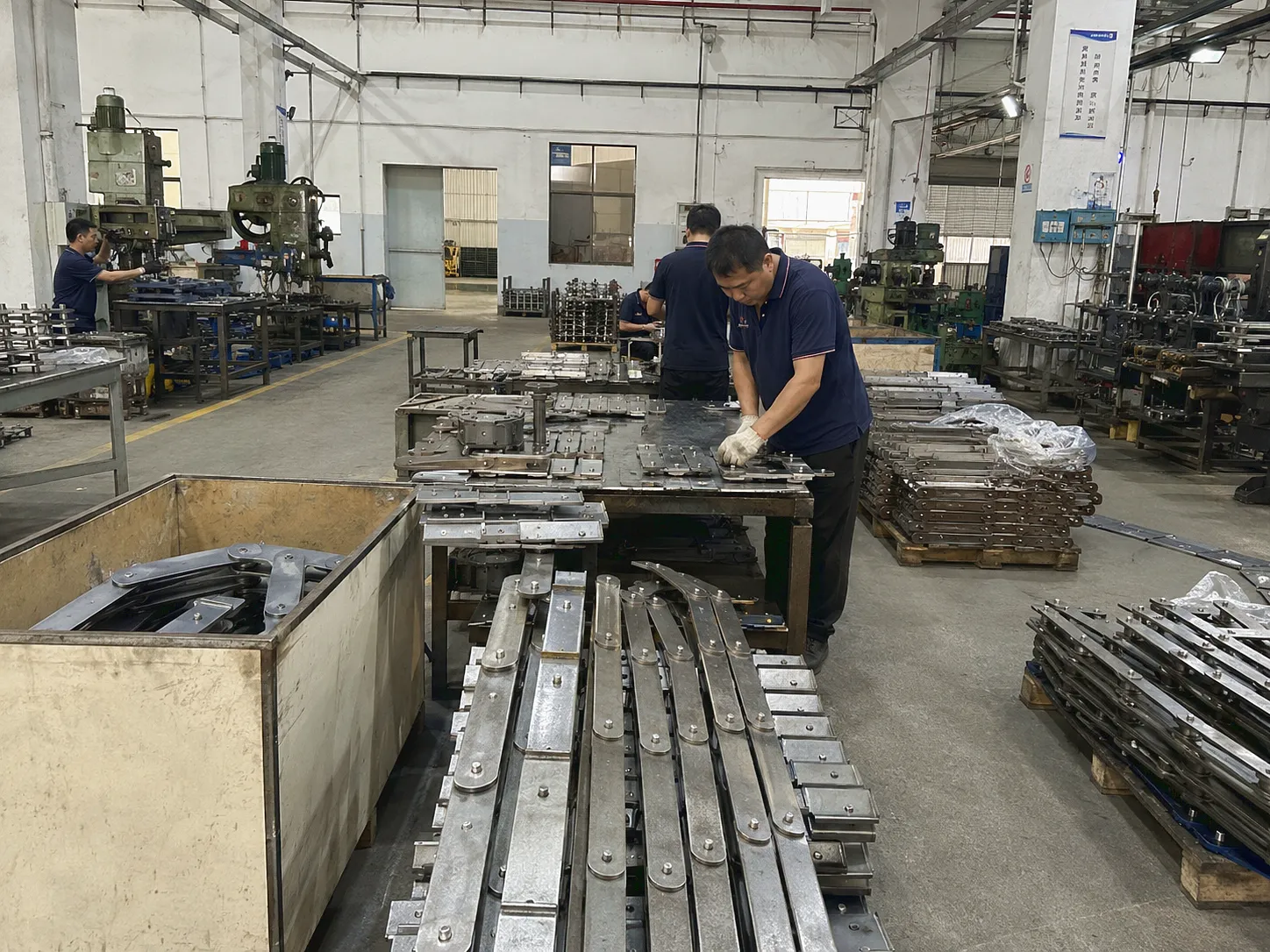
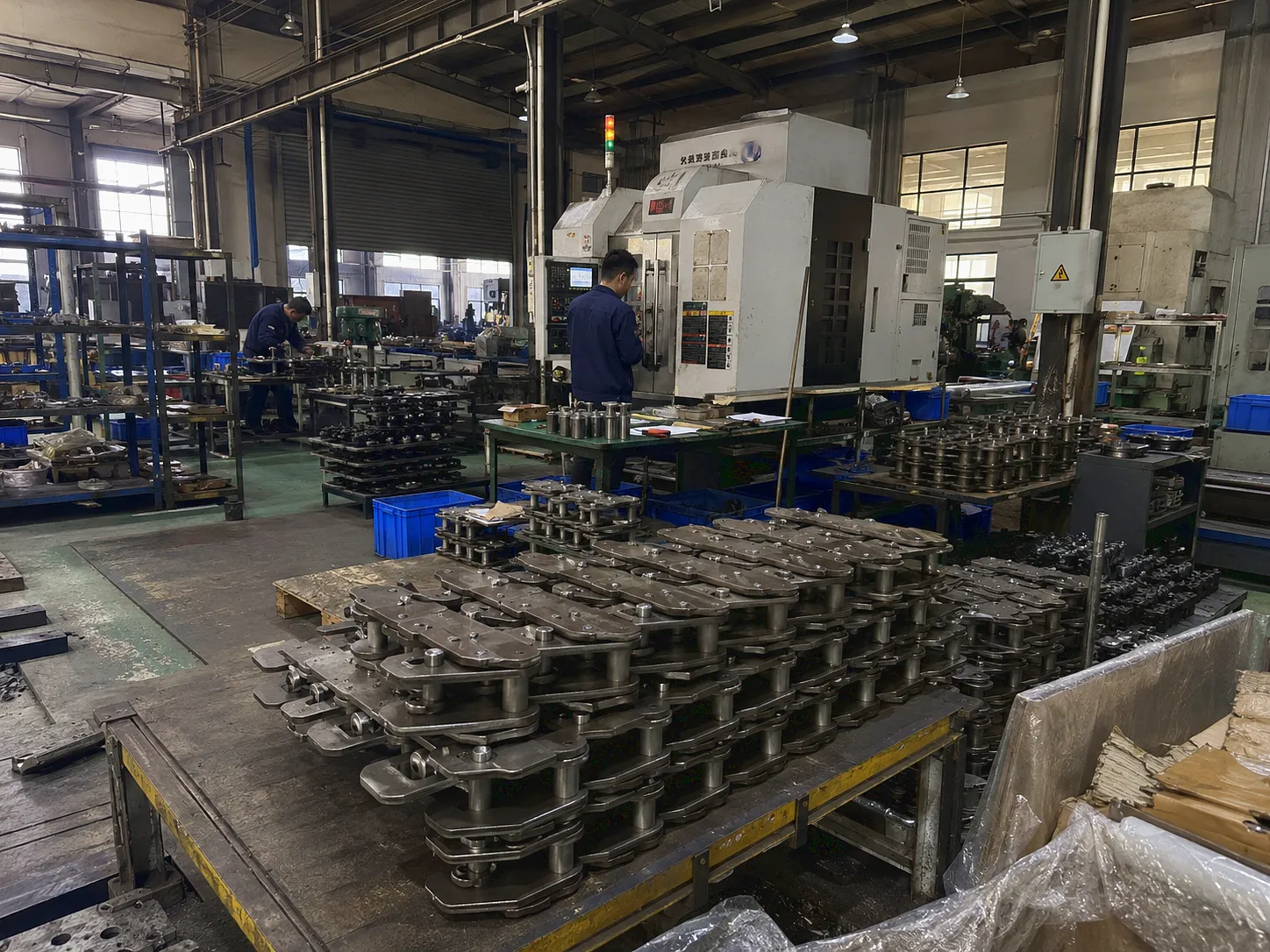
Behind every leaf chain that ships from our facility is a manufacturing process built on decades of refinement. Our production line combines precision stamping of link plates, CNC-controlled pin grinding, fully automated assembly, and 100% tensile pre-loading before dispatch. We do not rely on statistical sampling to verify breaking strength — every chain in a safety-critical series is proof-loaded to a defined percentage of its minimum breaking load before it is packaged. This is not the industry standard; it is our standard.
The custom engineering capability at EP is particularly valued by OEM forklift manufacturers, specialist attachment producers, and large fleet operators who have non-standard mast geometries or unusual duty cycle requirements. We can manufacture leaf chains to any customer-supplied drawing, including non-standard pitches, special plate profiles, modified anchor pin configurations, and proprietary lacing counts. Our engineering team works directly with customers’ design engineers to validate specifications before first production, and our in-house FEA capability allows us to model fatigue life under customer-specified load spectra.
For UK distributors and maintenance companies supplying the aftermarket, we offer co-branded packaging, custom chain lengths, and pre-assembled kits with end fittings matched to the specific OEM models in your customer base. Lead times for standard custom work run at 4–6 weeks from drawing approval; for complex novel designs, our project engineering team provides a timeline and DFM feedback within five working days of receipt of enquiry.
Customer Success: Real-World Results from UK & European Operations
Midlands Automotive 3PL — Fleet of 42 Electric Reach Trucks
 A third-party logistics provider operating a 240,000 sq ft distribution centre in Coventry, serving Tier 1 automotive component suppliers, was experiencing average leaf chain replacement intervals of 11 months across their 42-truck fleet. LOLER thorough examinations were consistently flagging chains at or near the 3% elongation threshold ahead of schedule, generating unplanned maintenance events and downtime on live sequencing lines. Annual chain replacement cost was running at approximately £38,000.
After conducting a detailed audit of the mast configurations, load profiles, and lubrication practices, our application engineering team recommended transitioning the entire fleet to EP BL 634 chains with a change to a dedicated EP-approved chain oil applied by automatic oilers. We also adjusted the examination scheme to include intermediate elongation checks at 6 months. The result was an average chain service life of 19 months — a 73% improvement — with zero unplanned mid-cycle failures in the 24 months following the programme change. Annual chain cost dropped to approximately £26,500 despite a higher unit price, delivering a net annual saving of around £11,500 and eliminating 11 unplanned line stoppages.
We run a mixed fleet of Linde and Toyota reach trucks across three sites in the North West. Switching to EP leaf chain about two years ago reduced our chain-related LOLER failures to near zero. The documentation package they provide genuinely simplifies our compliance reporting — our HSE advisor commented on it specifically.
We specified EP BLL 1044 for our 12-tonne counterbalance trucks at our steel stockholding site in Sheffield. The extended-pin configuration integrated perfectly with our non-standard mast anchor brackets. Lead time was four weeks and the engineering support before order was very thorough. Good people to work with.
Our cold store operation in Bristol runs at -22°C. Previous chain suppliers struggled to provide stainless variants that performed reliably below -15°C. EP’s 316L stainless leaf chain with food-safe lubricant has been running for 28 months now on our VNA trucks without any elongation issues at the last two LOLER examinations. That kind of reliability in our environment is genuinely hard to find.
Maximising Chain Service Life: Lubrication, Inspection & Replacement Intervals
The single maintenance action with the greatest impact on leaf chain service life is correct, consistent lubrication. A leaf chain working dry will wear at up to ten times the rate of the same chain with adequate oil film at the pin-plate interface. The correct lubricant is a penetrating chain oil with sufficient viscosity to provide a load-bearing film at operating temperature, low enough to wick into the pin-plate clearance, and resistant to water wash-off in wet environments. Engine oil, WD-40, and grease are all wrong choices for very different reasons — yet all three are regularly encountered in the field during chain audits.
The recommended lubrication interval for high-cycle forklift applications is every 200–250 operating hours, or more frequently in dusty, wet, or chemically aggressive environments. Automatic chain oilers — which deliver a metered dose of lubricant each time the chain travels over the sheave — are now cost-effective on high-duty trucks and deliver consistent lubrication that manual methods cannot match. If you are managing a fleet in the UK and have not yet evaluated automatic oilers, the ROI calculation is typically straightforward.
Elongation measurement should be conducted using a calibrated steel rule or dedicated chain wear gauge, measuring across a minimum of 12 pitches (and always the same reference section, marked with paint at initial installation). Measure with the chain under a standard reference tension — typically 5–10% of working load limit — to remove the effect of joint slackness on the reading. Compare against the new-chain length for that section, and replace when elongation reaches 3% or the chain manufacturer’s stated limit, whichever is more conservative.
Lubricate every 200–250 hours; more in wet or dusty environments
Measure elongation across 12+ pitches at a marked reference section
Replace at 3% elongation — do not extend beyond this threshold
Inspect anchor pins, clevis fittings, and sheave grooves simultaneously
Always replace both chains in a two-chain mast at the same time
LOLER thorough examination minimum every 12 months — retain records
Comparison: Leaf Chain Performance by Operating Environment
| Operating Environment | Recommended Chain Grade | Lube Interval (hrs) | Typical Life (months) | Special Considerations |
|---|---|---|---|---|
| Ambient warehouse (dry) | Standard alloy steel BL | 250 | 18–24 | Standard chain oil; auto-oiler recommended on high-cycle trucks |
| Cold store (-25°C to -5°C) | 316L stainless BL | 150 | 22–30 | Food-safe lubricant essential; condensation corrosion risk on entry/exit |
| Outdoor / port (wet exposure) | Alloy steel BL / BLL (coated) | 150 | 12–18 | Water-resistant lubricant; zinc-nickel plate finish option available |
| High-temp (foundry / forge) | High-temp alloy BL | 100 | 8–14 | Synthetic high-temp lubricant; heat shield guards on mast if possible |
| Dusty / abrasive (cement, minerals) | Hardened alloy steel BL | 100–150 | 10–16 | Flush chain before lubrication; consider sealed-pin or coated options |
Supplying UK Forklift Operators: From Aberdeen to Plymouth
EP Leaf Chain supplies forklift operators, OEM manufacturers, and specialist distributors across the United Kingdom, including Scotland, England, Wales, and Northern Ireland. Our distribution arrangement supports next-day delivery on standard BL and BLL series chains to most UK postcode areas, making us a practical supplier for both planned replacement programmes and emergency breakdown situations.
We work with forklift dealers in the logistics hubs of the East Midlands, the major port complexes at Felixstowe, Tilbury, and Southampton, and the manufacturing corridors of the West Midlands and Yorkshire. Understanding the specific operating conditions common to each of these environments — the salt air at coastal ports, the temperature cycling in cold chain facilities, the abrasive dust in agricultural and minerals handling — is part of how we advise customers rather than simply selling product. If your operation has a specific challenge, bring it to us. There is very rarely a scenario we have not seen before.
Tell us your mast type, rated capacity, and operating environment. We will recommend the correct chain series, dimensions, and maintenance programme.
Frequently Asked Questions
This article was prepared by EP’s application engineering team, drawing on direct field experience with forklift OEMs, fleet operators, and maintenance contractors across UK and international projects. Technical content is reviewed against current ISO 4347 and LOLER 1998 requirements. For project-specific technical enquiries, contact us directly.