
Industrial Chain Engineering · Telehandler Applications · United Kingdom
Leaf Chain for Telehandlers:
The Engineering Truth Behind
Every Safe Lift
When a telescopic handler extends its boom to six metres and holds a half-tonne pallet against a UK building site wind, the component doing the real work is not the hydraulic cylinder — it is the leaf chain running through the mast. This guide examines why the choice of leaf chain determines whether your telehandler performs or fails.
Why Leaf Chain Is the Backbone of Every Telehandler
 The telescopic handler — known variously as a telehandler, tele-truck, or reach forklift — represents one of the most mechanically demanding machines on modern construction, agricultural, and logistics sites across the United Kingdom. Its defining feature, the extendable boom, must raise, tilt, and extend loads at angles that generate enormous side forces on every mechanical component in the lifting circuit. At the centre of this circuit sits the leaf chain: a flat-link, pin-jointed assembly engineered to transmit tensile force with virtually zero elongation under working load.
Unlike roller chain, which is designed for wrap-around sprocket drives, leaf chain — also written as lacing chain or BL/AL series chain — is a purely tensile load member. It runs over sheaves rather than sprockets, making it ideally matched to the reciprocating linear movement found in forklift masts, telehandler boom circuits, and hydraulic cylinder balancing systems. The geometry means every single outer link and inner link plate must bear load simultaneously, distributing stress across multiple parallel laminations and giving leaf chain a tensile strength that is genuinely remarkable relative to its compact cross-section.
For UK telehandler operators working on sites governed by LOLER (Lifting Operations and Lifting Equipment Regulations 1998) and PUWER (Provision and Use of Work Equipment Regulations 1998), chain quality is never a cost-optimisation exercise — it is a statutory compliance requirement. A worn or substandard leaf chain can precipitate catastrophic boom drop, potentially fatal to the operator and bystanders alike.
Construction, Materials, and Operating Principles
Understanding how a leaf chain is actually built is essential for engineers specifying equipment for demanding British work environments — from Scottish highland estate equipment to port logistics in Southampton or Bristol.
Link Plate Lacing
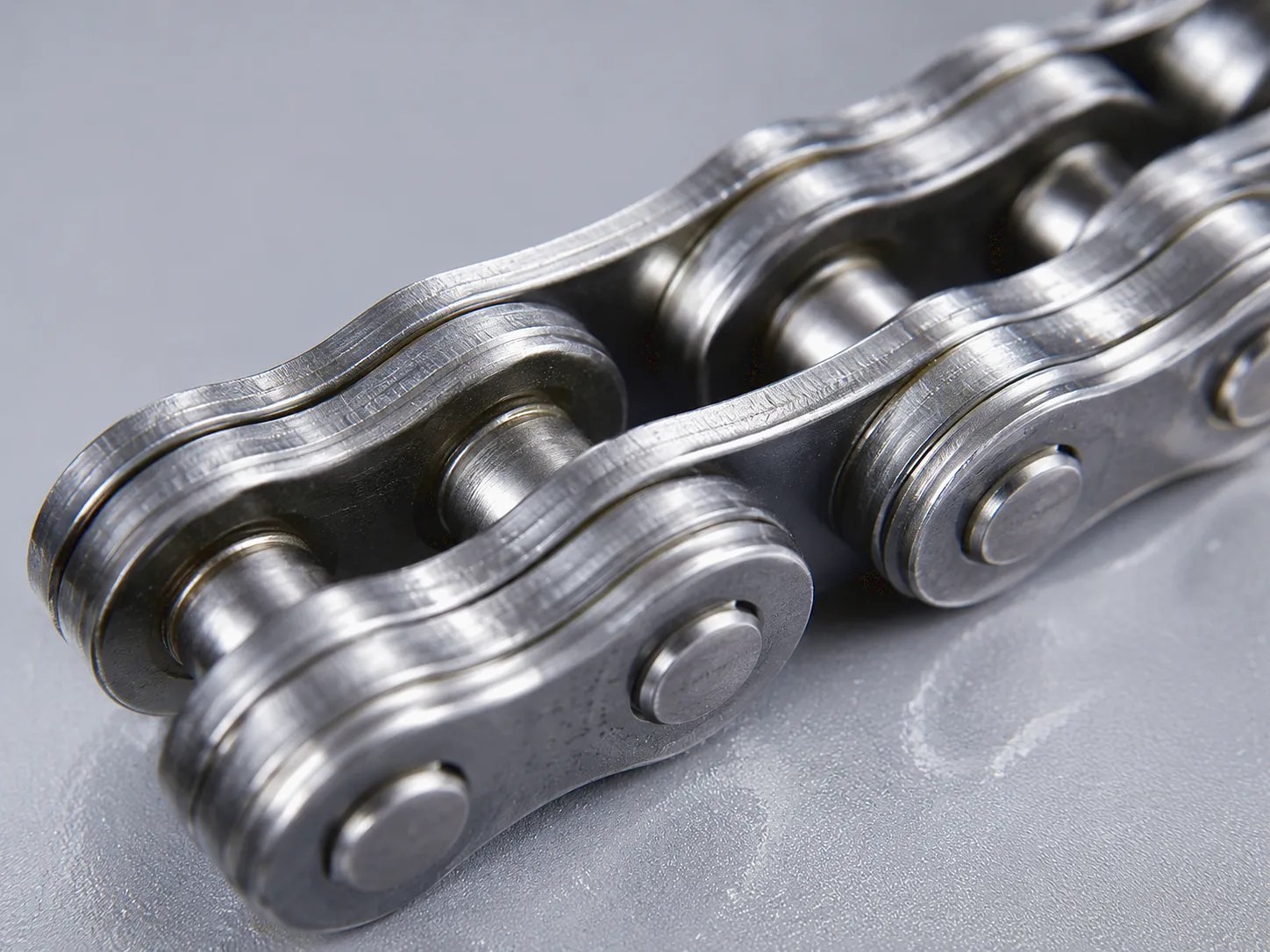
Multiple inner and outer link plates are stacked in pairs and joined by through-hardened pins. The lacing pattern — such as 2×2, 3×3, 4×4, or 6×6 — determines tensile capacity. More lacing = higher load rating at the same pitch.
Pin & Bush Material
Pins are typically manufactured from case-hardened alloy steel — commonly 40Cr or 20CrMnTi — surface hardened to 58–62 HRC via carburising. This hard outer shell resists abrasive wear while the ductile core absorbs shock without brittle fracture.
Link Plate Steel Grade
Link plates are precision-stamped from alloy carbon steel strip (tensile ≥ 1000 MPa after heat treatment). Controlled thickness tolerance — typically ±0.02 mm — ensures uniform load sharing across all laminations, eliminating the hot-spot fatigue failures common in lower-quality chain.
Surface Finish Options
Standard self-colour, hot-dip galvanised, nickel-plated, and shot-peened finishes are available. For UK agricultural telehandler duty — where slurry, silage acids, and constant washdown are routine — a zinc-phosphate primed and polymer-top-coated chain extends service intervals considerably.

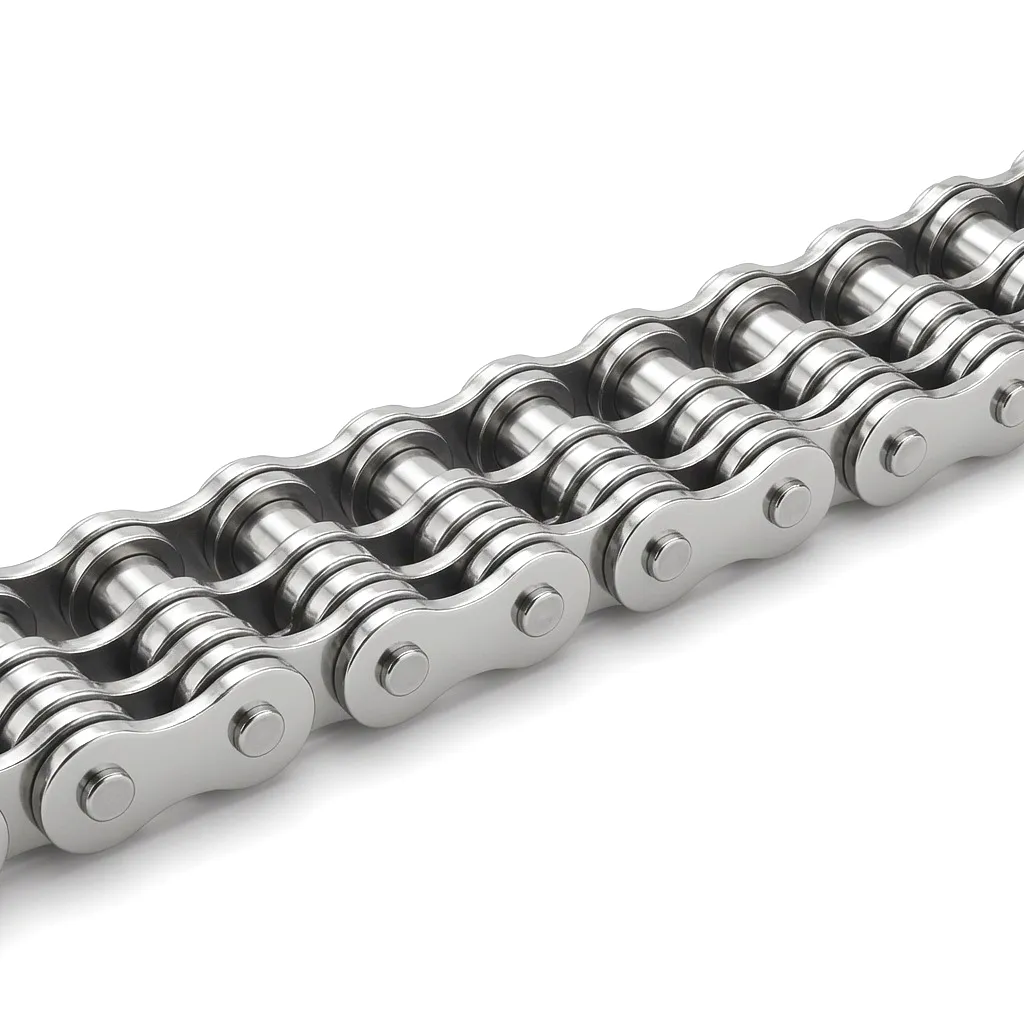
Close-up of precision link-plate lacing and hardened pin assembly — Ever Power leaf chain
The interplay between lacing count, pitch, and plate width gives engineers a three-dimensional design space. A BL634 (3×4 lacing, 19.05 mm pitch) and a BL844 (4×4 lacing, 25.4 mm pitch) can both meet a given tensile requirement, but the finer-pitch option allows a smaller sheave diameter, directly reducing the overall envelope of the boom head assembly. This kind of trade-off is something Ever Power’s engineering team works through with OEM customers in detail before any quotation is finalised.
Technical Performance Parameters
Representative data for Ever Power BL / AL Series leaf chain. Custom specifications available on request.
| Chain Series | Pitch (mm) | Cadarço | Min Break Load (kN) | Working Load (kN) | Pin Diameter (mm) | Plate Width (mm) | Typical Telehandler Duty |
|---|---|---|---|---|---|---|---|
| BL422 | 12.70 | 2×2 | 34.3 | 8.6 | 5.08 | 16.0 | Light duty / auxiliary |
| BL634 | 19.05 | 3×4 | 107.8 | 26.9 | 9.525 | 36.0 | 3–4 t compact telehandler |
| BL844 | 25.40 | 4×4 | 187.0 | 46.8 | 12.700 | 48.0 | 4–6 t standard telehandler ✓ |
| BL1046 | 31.75 | 4×6 | 266.0 | 66.5 | 15.875 | 60.0 | 6–8 t heavy ag/construction ✓ |
| BL1266 | 38.10 | 6×6 | 400.0 | 100.0 | 19.050 | 72.0 | Extreme-duty / port handlers |
Working load = minimum break load / 4 (safety factor per ISO 4347). Custom pitches, lacings and end fittings available. Contact Ever Power for project-specific calculations.
The Telehandler Application: Forces, Failures, and the Right Chain
A modern telescopic handler in agricultural service — as used extensively across Yorkshire, Lincolnshire, and the Welsh Borders for hay bale stacking, grain bag handling, and slurry kit manoeuvring — typically cycles its boom thousands of times per season. Each cycle involves a combined tensile and bending load on the leaf chain as the boom extends and retracts while simultaneously lifting or lowering. The chain must maintain precise positional relationship between the inner and outer boom sections, ensuring smooth carriage movement and accurate fork positioning. Any elongation beyond 3% of the chain’s nominal pitch length — the ISO 4347 wear limit — risks misalignment that accelerates sheave wear and introduces dangerous play into the lifting circuit.
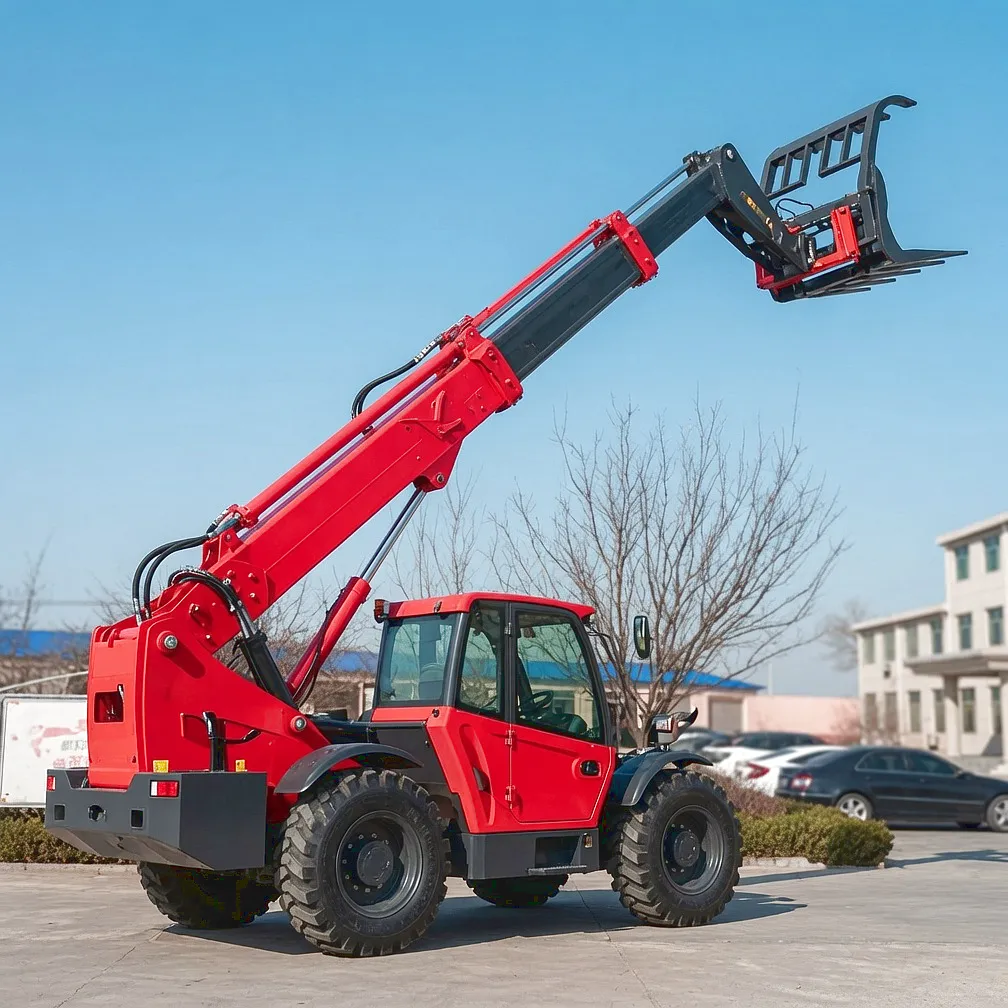
Construction-duty telehandlers — the kind found on housebuilding sites from Swindon to Edinburgh, placing block pallets, brick cubes, and scaffold boards — face a different but equally severe challenge. The short, intense duty cycles of construction create high peak loads rather than steady fatigue; the chain must handle sudden load applications without link plate yielding. Ever Power’s manufacturing process incorporates a controlled pre-tensioning (proof-load) step after assembly, which seats all pin-to-plate interfaces and eliminates initial elongation that would otherwise appear in the first few hundred cycles of field service.
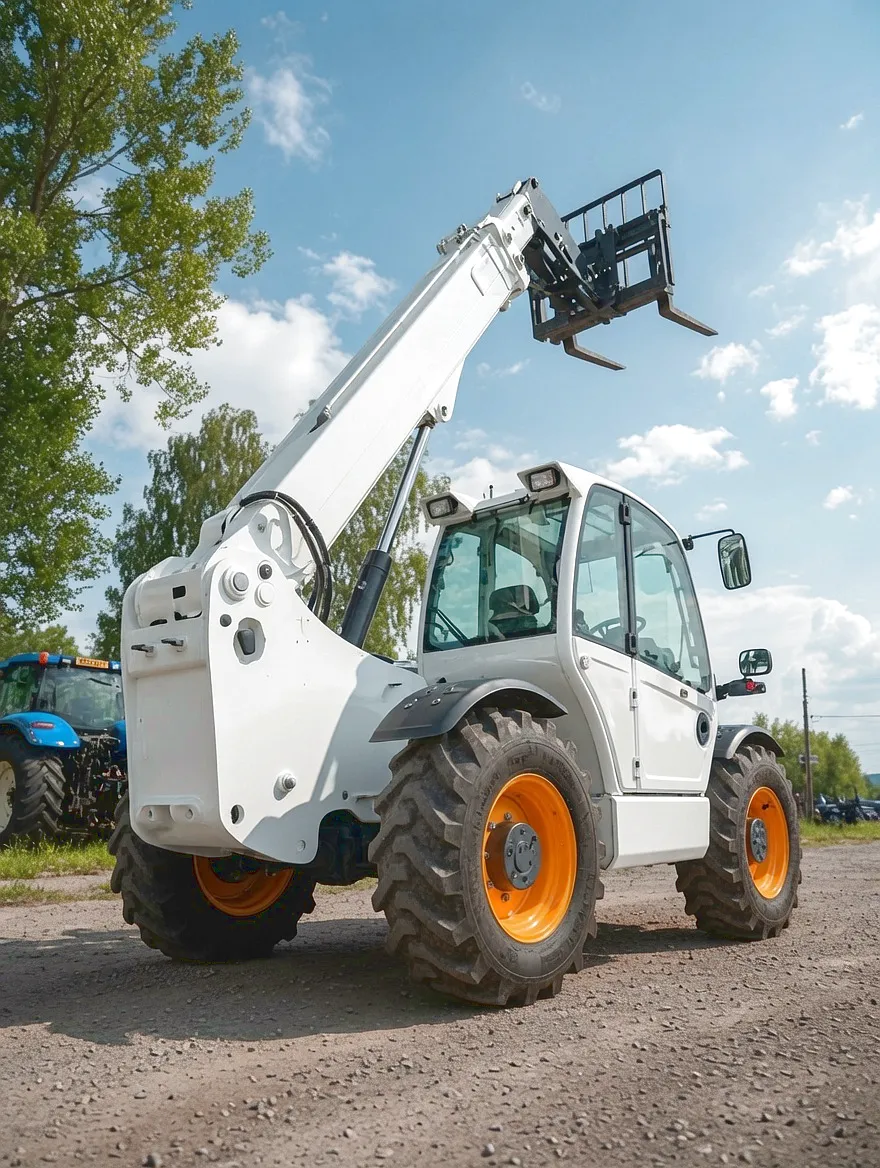
Telehandler on active construction duty — the boom chain runs through every lift cycle
The chain’s role within a telehandler’s boom circuit differs from its role in a counterbalance forklift mast. In a forklift, the chain typically runs in a single vertical plane and encounters relatively clean, lubricated conditions. A telehandler chain, by contrast, articulates through three-dimensional boom movement, operates at angles that generate side-loading on the sheave flanges, and is often exposed to outdoor environments — mud, grass seed, dust, and in coastal counties such as Devon, Dorset, and Norfolk, salt-laden air that accelerates corrosion at the pin-to-plate interface. Specifying the correct surface protection is therefore just as important as selecting the right tensile rating.

Agricultural telehandler duty — bale handling
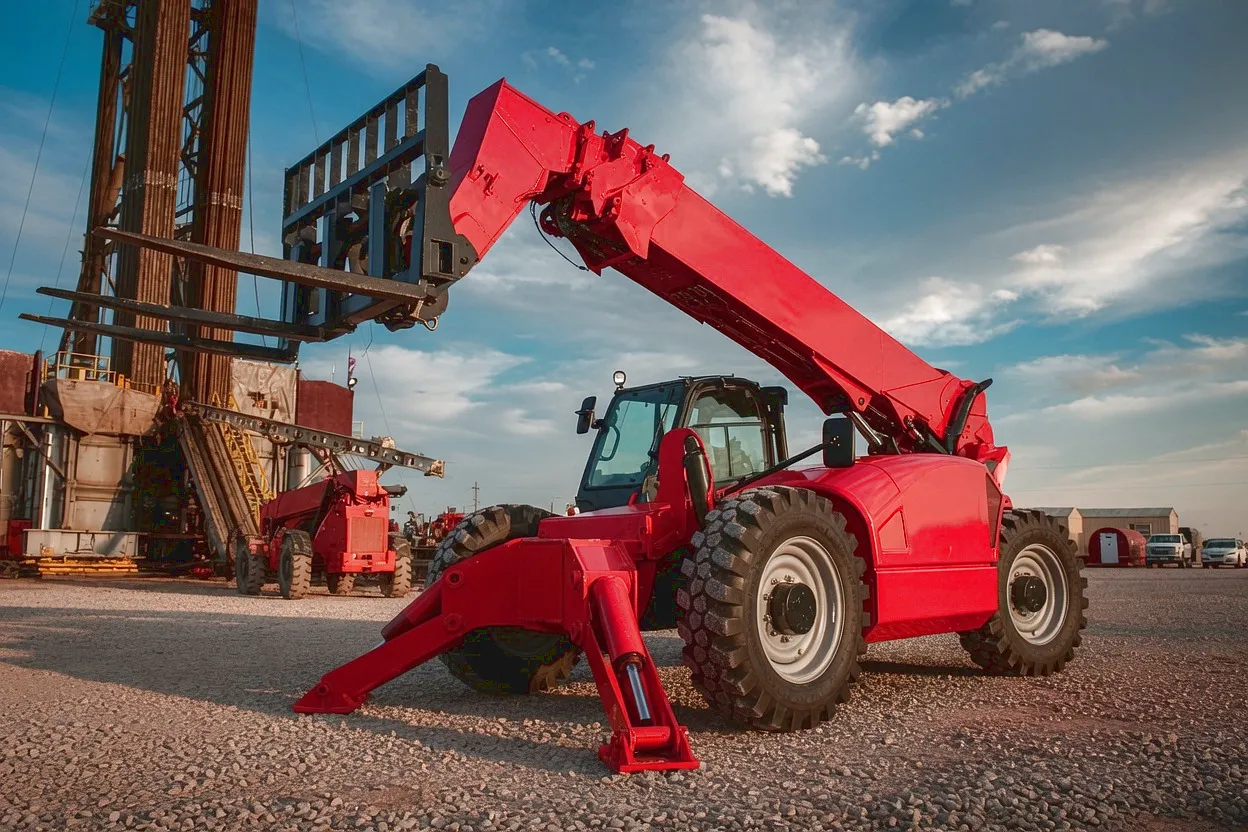
Warehouse & logistics reach telehandler
Where Leaf Chain Drives Telehandler Performance
Six critical duty environments — each with distinct chain specification requirements.
Construction & Housebuilding
Placing block pallets, brick cubes, and roofing materials at height demands peak-load resistance and zero elongation. Sites governed by CDM regulations require traceable chain certification. BL844 and BL1046 series are standard specification for 4–6 t machines working at maximum rated height. The cycle demands are high-intensity and short — exactly the duty profile that reveals inferior link-plate stamping.
Agriculture & Arable Farming
Across UK arable counties — Cambridgeshire, Lincolnshire, East Riding — telehandlers stack round bales, handle grain bags, move slurry kit, and assist with lambing barn logistics. The combination of constant dust, fertiliser residue, and seasonal washdown creates aggressive corrosion conditions. Zinc-phosphate primed and galvanised chain finishes with extended lubrication intervals are strongly recommended for this environment.
Port & Container Logistics
Ports such as Felixstowe, Southampton, and Grimsby operate reach telehandlers around the clock. Salt-laden air, continuous shift patterns, and loads approaching maximum rated capacity create the most demanding possible duty cycle. Nickel-plated BL1266 chain with scheduled inspection records is the appropriate solution; full traceability documentation is supplied as standard by Ever Power for port operator compliance.
Quarrying & Aggregates
UK quarry sites from the Cotswolds limestone belt to Pennine gritstone operations use telehandlers alongside loading shovels for aggregate bin management, crusher feed, and workshop material handling. Dust ingress into the chain assembly is the primary failure mode in this environment; sealed-pin chain variants with tight pin-to-plate clearances dramatically reduce abrasive contamination and extend service life.
Manufacturing & Distribution
Automated distribution centres — increasingly common in the Midlands logistics corridor and the M4/M5 corridors — use telehandlers for high-bay rack loading where extended reach at height is essential. Indoor conditions favour standard self-colour chain, but the high cycle counts (often 200+ lifts per eight-hour shift) demand a chain with verified fatigue life data, supplied with batch test certificates matching the serial numbers on the chain itself.
Forestry & Land Management
Scottish and Welsh forestry operations present a combination of steep gradient working, waterlogged ground, and heavy log bundle loads that stress both the telehandler structure and its chain to extremes rarely encountered in conventional industrial lifting. Heavy-duty BL1046 and BL1266 chains in galvanised finish have demonstrated the greatest reliability in these environments, where access for maintenance is limited and chain failure means an expensive recovery operation in remote terrain.
Why Ever Power Leaf Chain Outperforms the Alternatives
Certified to ISO 4347 & DIN 8152
Every chain batch is proof-tested and dimensional inspection records retained. For UK customers requiring LOLER-compliant lift equipment, this traceability is not optional — it is the difference between a passed inspection and a prohibition notice.
Precision Pin Manufacture
Ground and polished pins manufactured to ±0.005 mm diameter tolerance ensure consistent pin-to-plate press-fit and eliminate the micro-movement that initiates fretting corrosion — the silent killer in outdoor telehandler chain applications.
OEM Replacement Compatibility
Ever Power maintains cross-reference data for all major telehandler brands operating in the UK market. Whether you are replacing chain on a JCB 540-200, a Manitou MT-X or a Merlo P40, the correct equivalent specification can be confirmed before shipment, avoiding costly re-orders.
Extended Lubrication Intervals
Shot-peened link plates and precision-matched pin/plate clearances allow the factory-applied lubricant to remain effective up to twice as long as commodity chain alternatives, reducing maintenance downtime on high-value plant without compromising wear performance.
Custom Length & End Fitting
Chains are cut to exact working length and supplied with anchor pins, clevis anchors, adjusting bolts, or threaded rod ends as required by the telehandler model. This eliminates on-site modification, which is a common source of installation errors and, consequently, premature chain failure in the field.
Full Documentation Package
Material certificates, dimensional inspection reports, proof-load test records, and UKCA/CE declarations of conformity are supplied as standard with every commercial order — giving equipment hirers, plant managers, and LOLER thorough examiners the paper trail they legally need.
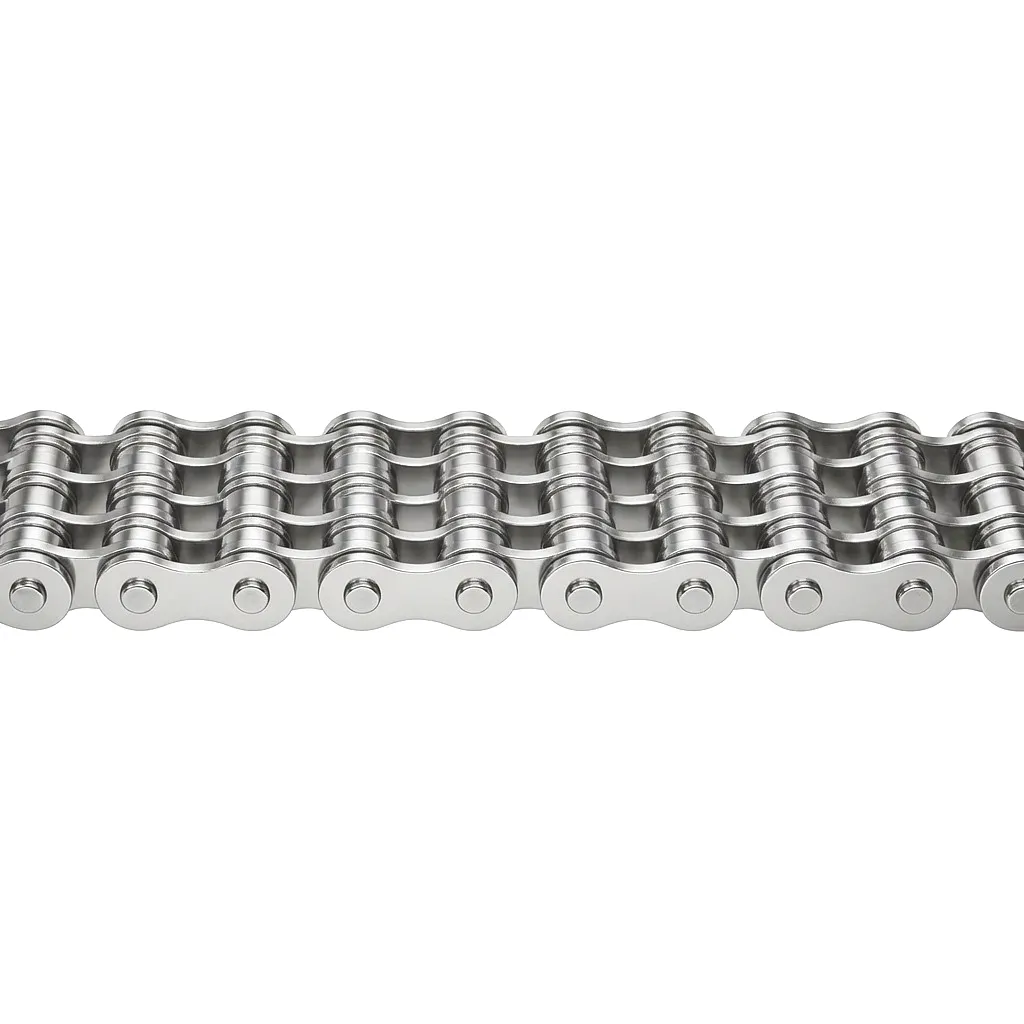
Assembled leaf chain with end fittings — cut-to-length and certified, ready for telehandler installation
Manufacturing & Custom Engineering: Built for Your Machine
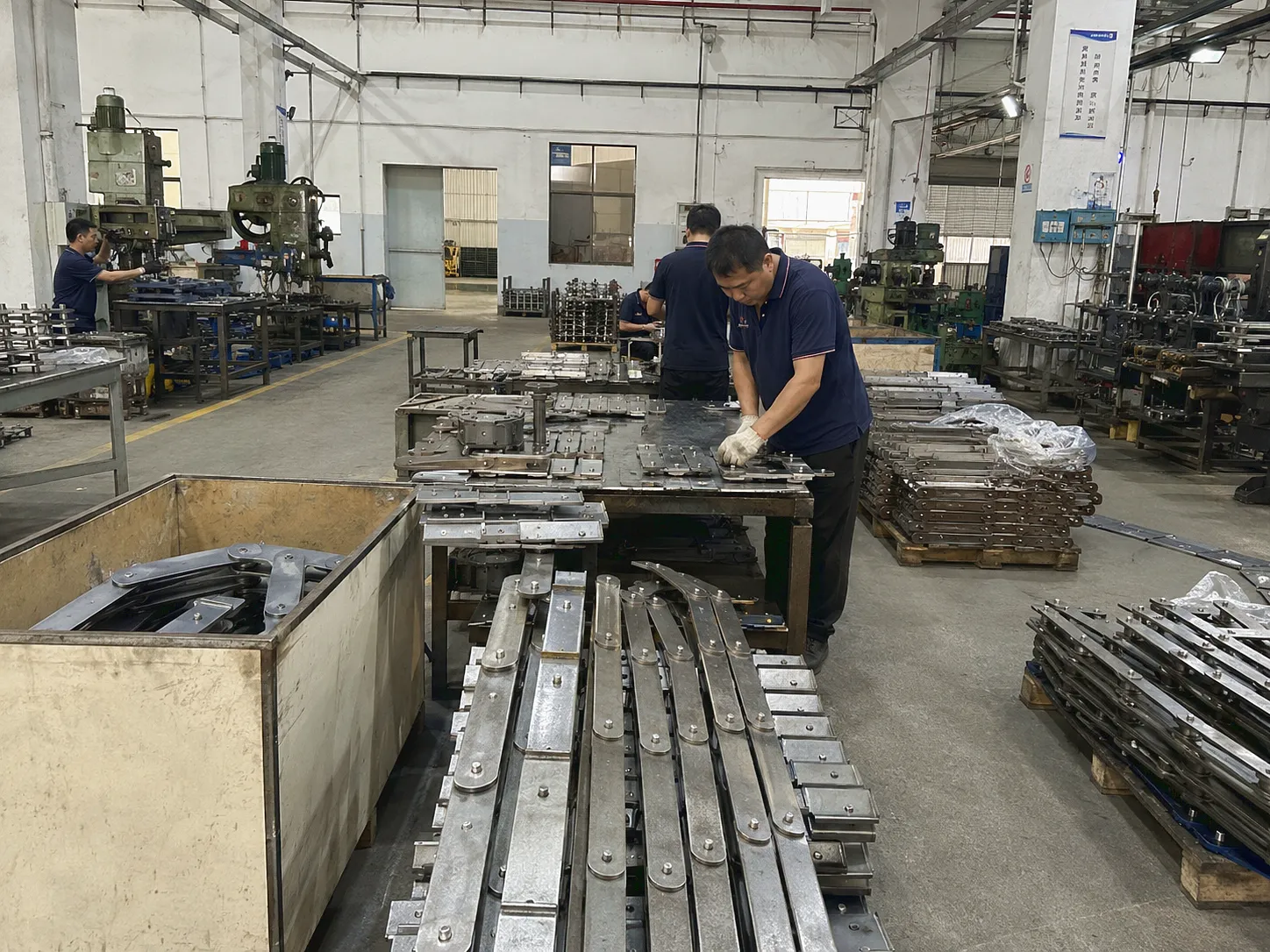
Ever Power manufacturing facility — vertical integration from steel strip to finished chain
Ever Power operates dedicated manufacturing lines for leaf chain production, with pressing, heat-treatment, assembly, and testing all contained within a single quality-managed facility. This vertically integrated model — uncommon among chain suppliers who buy in components — gives Ever Power the ability to adapt specifications rapidly and with complete process visibility. When a UK telehandler OEM or distributor requires a non-standard pitch, a special end-fitting geometry, or an unusual lacing pattern to retrofit an older machine model, Ever Power can produce prototype samples within days rather than the weeks typical of intermediary-sourced supply chains.
The factory’s CNC pin-grinding line produces pins to submicron roundness tolerances, while the stamping press tools are maintained with a certified calibration programme that ensures plate thickness consistency across every production run. Heat treatment is carried out in atmosphere-controlled carburising furnaces, with hardness verification performed by Vickers testing on production samples taken at defined intervals per batch — not simply at the start of a run.
For UK importers and plant dealers managing multiple telehandler model fleets, Ever Power offers a managed supply programme: agreed stock levels maintained at the factory warehouse, call-off orders with a 48-hour dispatch window, and a fixed pricing structure covering the agreed product range for the contract term. This eliminates the feast-and-famine supply pattern that plagues seasonal agricultural markets and the unpredictable price volatility common in commodity steel components.
Custom Pitch & Lacing
to Drawing
Special End Fittings
& Anchor Assemblies
Surface Coating
Specification
LOLER / UKCA
Documentation Pack
OEM White-Label
Supply Programme
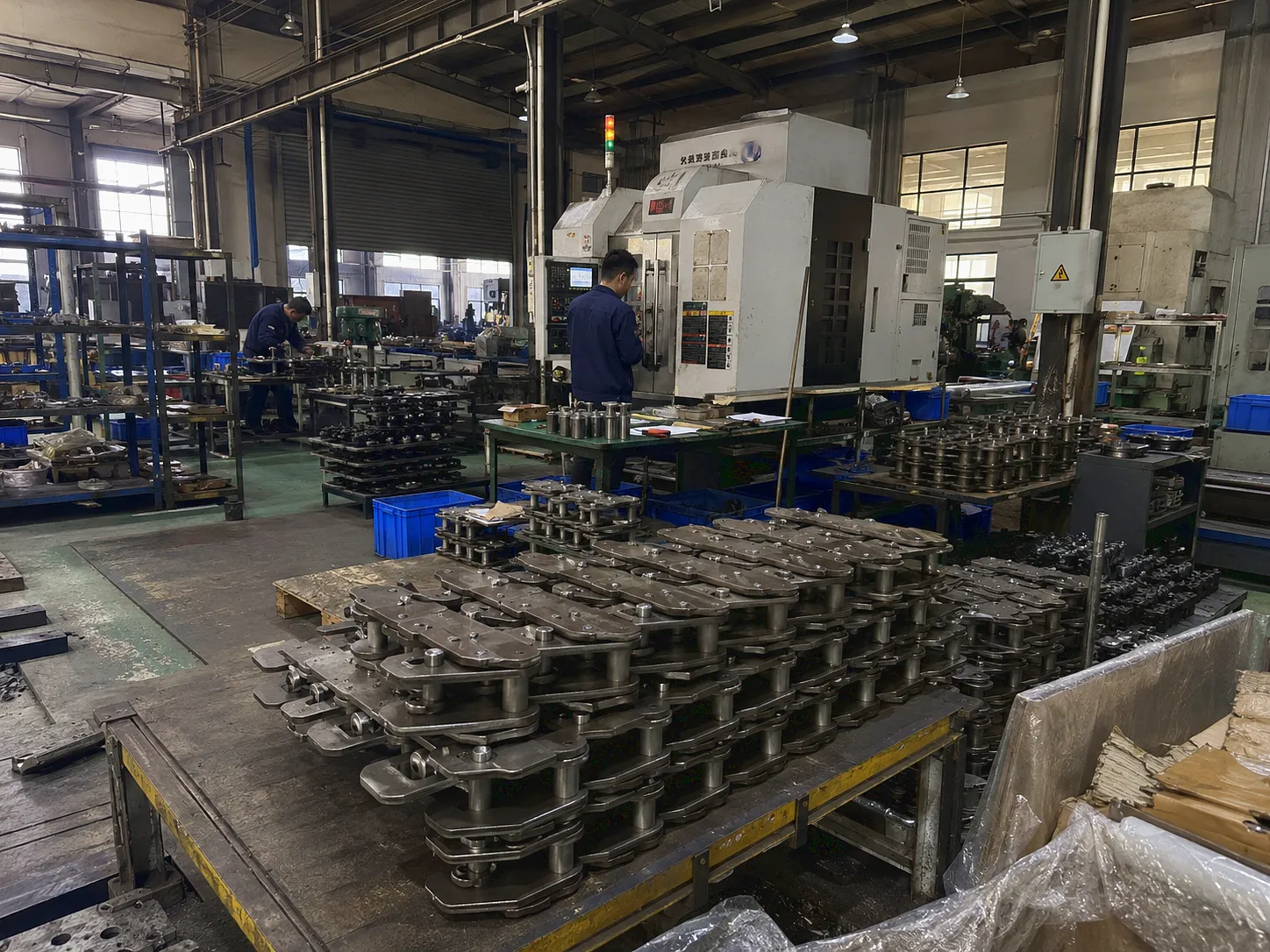
Quality assurance and proof-load testing — standard procedure for every Ever Power production batch
Customer Success: From Chain Failure to Zero Downtime
Case Study · Yorkshire, UK · Agricultural Contracting
Harrogate Agricultural Services Ltd — Fleet Chain Upgrade
Background: Harrogate Agricultural Services operates a mixed fleet of 11 telehandlers — primarily JCB and Manitou models ranging from 3.5 t to 6 t capacity — servicing arable farms across the Vale of York and the Wolds. Annual utilisation averages 1,400 operating hours per machine, with peak seasonal demand during harvest pushing some machines to 14-hour days across six-week periods.
The Problem: Prior to engaging Ever Power, the fleet was sourcing replacement cadeia de folhas from a regional agricultural merchant who stocked a single commodity-grade chain in four sizes. In the 2022 harvest season, three machines suffered chain failure within six weeks: two elongation failures requiring emergency replacement, and one outer link plate crack that resulted in a partial boom-drop incident — fortunately with no personnel injury. The LOLER thorough examination contractor placed two machines on prohibition pending investigation, costing the business approximately £18,000 in lost hire revenue and emergency repair costs.
The Solution: Following contact via the Ever Power inquiry process, the technical team conducted a full review of the fleet specifications, operating hours, and failure history. The previous chain had been BL844 commodity grade with no material certification. Ever Power supplied BL844 and BL1046 chains as appropriate by machine rating, galvanised finish, with full material certificates, proof-load test records, and a recommended inspection schedule based on actual operating hours. A managed supply arrangement was established with a dedicated UK freight partner, ensuring same-week delivery of replacement chains during harvest season. In the two subsequent harvest seasons, the fleet recorded zero chain-related stoppages across 22,000 combined operating hours.
Results at a Glance
0
Chain failures in 22,000 hrs post-upgrade
£18k+
Annual downtime cost eliminated
11
Telehandlers under managed supply
What Our Customers Say
We run eight telehandlers on housebuilding sites across the East Midlands, and chain quality directly affects our LOLER examination pass rate. Since switching to Ever Power, we have had no advisory notices and no unexpected replacements in 18 months. The documentation they supply saves our maintenance team hours every inspection cycle.
— D. Fairweather, Plant Manager
Nottinghamshire Construction Services Ltd, UK
We operate three reach telehandlers at our Suffolk logistics facility on rotating shifts, so chain wear is a genuine operational risk. Ever Power matched the exact chain spec to our Merlo machines, supplied with batch test certificates, and arranged next-week delivery. The price was competitive and the paperwork was actually correct, which is rarer than you would think in this industry.
— R. Lim, Operations Director
Eastern Logistics Distribution Ltd, Ipswich, UK
We quarry limestone in Derbyshire and the dust environment destroys standard chain in under 1,000 hours. After discussing our problem with the Ever Power technical team, they recommended their sealed-pin variant in BL1046 with galvanised finish. We are now past 2,200 hours on the current set with no measurable elongation at the last inspection. The cost per operating hour is a fraction of what we were paying for annual chain replacement.
— T. Bradshaw, Workshop Superintendent
Peak District Quarrying Ltd, Bakewell, UK
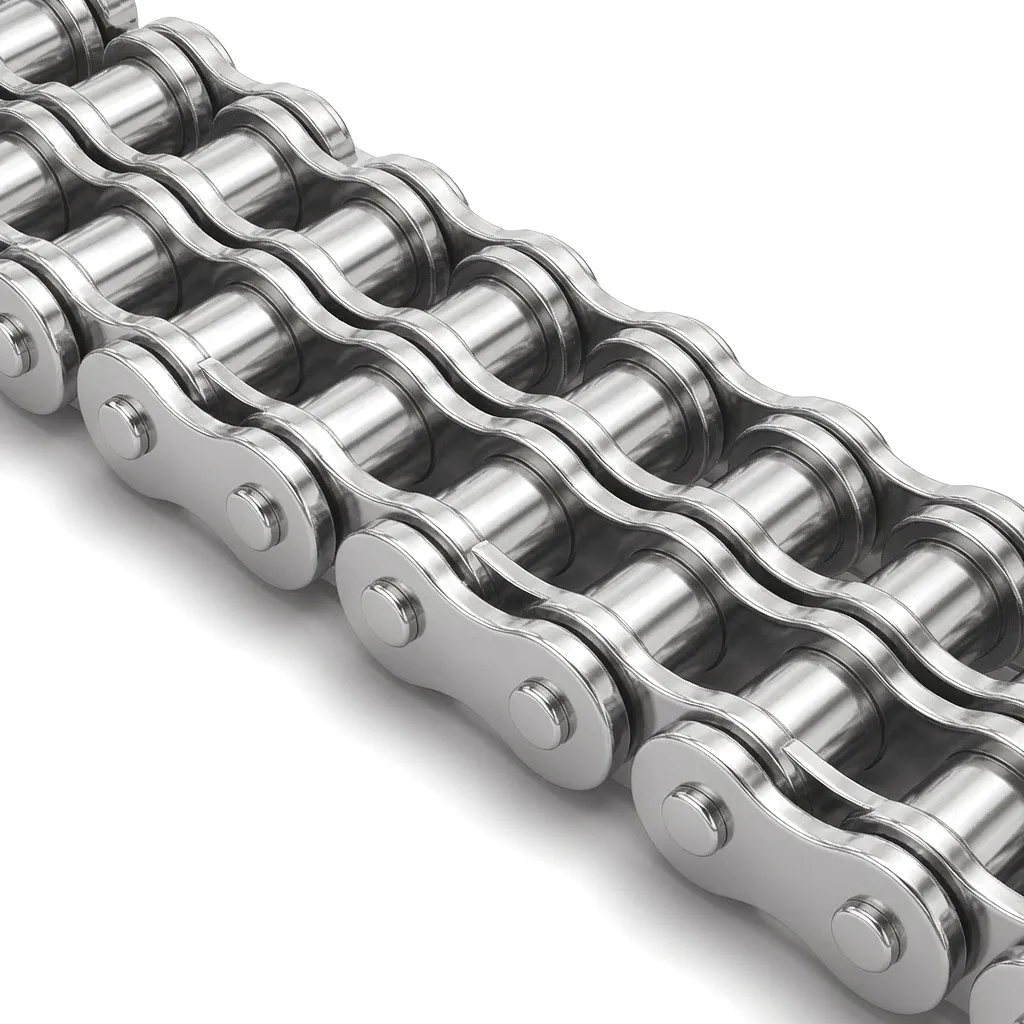
Ever Power BL series — the complete leaf chain range for telehandler and industrial lifting duty
Anchor pin end fitting detail — precision machined to telehandler OEM tolerances
Leaf chain is one of the smallest components in a telehandler by mass, yet it determines the safety and reliability of every lifting operation the machine performs. Getting the specification right — pitch, lacing, surface finish, end fitting geometry, and documentation — requires both product knowledge and an understanding of the specific duty environment. That is precisely the combination Ever Power brings to every customer inquiry.
Whether you are a UK plant dealer sourcing OEM-equivalent replacement chain for a large hire fleet, a telehandler manufacturer needing a custom chain assembly for a new model, or a site plant manager sourcing the right chain for a specific application, the path to the correct specification begins with a conversation. Ever Power supplies telehandler leaf chain to customers across England, Scotland, and Wales, with export documentation for European and global shipments.
Perguntas frequentes
Real questions from UK plant managers, fleet engineers, and LOLER examiners.
What is the correct leaf chain specification for a JCB 540-200 telehandler used on a UK construction site?
How often should I replace the leaf chain on a telehandler operating in UK agricultural conditions with heavy seasonal use?
Where can I get a competitively priced quote for bulk leaf chain supply to a UK plant hire business managing multiple telehandler models?
What is the difference between BL series and AL series leaf chain, and which one does my Manitou telescopic handler need?
How does leaf chain in a telehandler boom circuit differ from the chain used in a standard counterbalance forklift mast assembly?
Which UK regulations specifically cover the inspection and replacement of leaf chains on telehandlers used on construction and agricultural sites?
Can Ever Power supply custom-length leaf chain cut to the exact working dimension for a non-standard or older telehandler model operating in the UK?
Ready to Specify the Right Leaf Chain for Your Telehandler?
Ever Power supplies BL/AL series leaf chain to plant dealers, OEMs, and fleet operators across the United Kingdom and globally. Custom lengths, special finishes, and full LOLER documentation available on all commercial orders.
✉ Get a Quote — [email protected]
© Ever Power Industrial Chain Group · leaf-chain.com · Leaf Chain for Telehandlers · UK & Global Supply
editado por gzl